

 Chinese
- HOME >> NEWS >> Industry news
NEWS
Latest Product
Contact Us
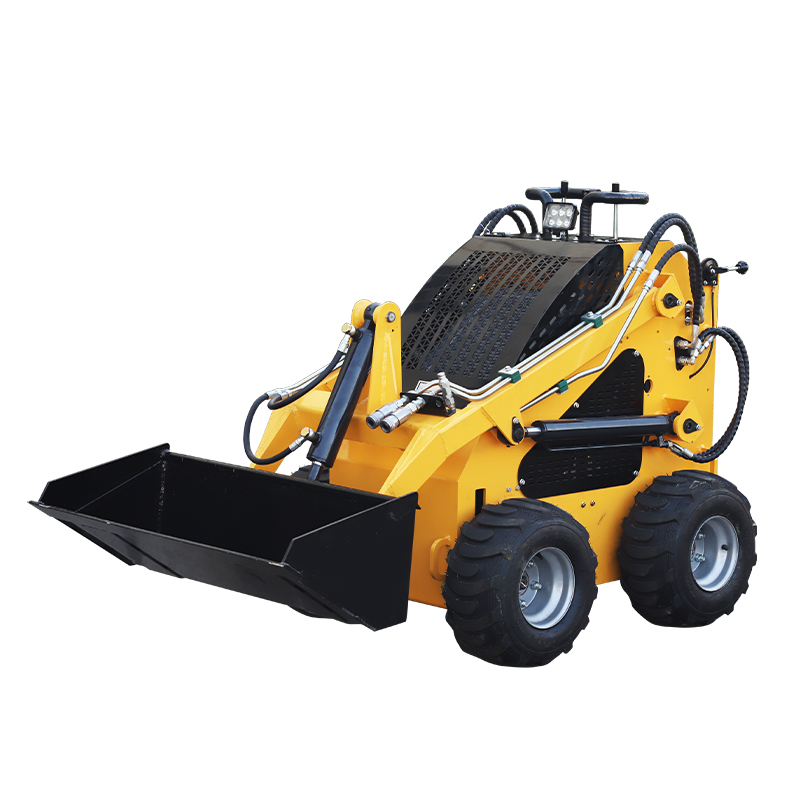
What are the main differences between a skid-steer loader and a traditional loader?
2025-06-19Skid-steer loaders and traditional loaders (such as wheel loaders or track loaders) differ significantly in structure, functionality, and application scenarios. The key distinctions are as follows:
Steering Mechanism
Skid-Steer Loader: Uses skid-steering, where the left and right wheels or tracks are independently driven. Turning is achieved by varying the speed of each side, allowing for an extremely small turning radius or even zero-turn (pivoting in place).
Traditional Loader: Typically employs articulated steering or rear-wheel steering, resulting in a larger turning radius and less maneuverability.
Size and Mobility
Skid-Steer Loader: Compact and lightweight, suitable for confined spaces (e.g., warehouses, indoor sites, construction zones).
Traditional Loader: Larger in size, designed for open areas (e.g., mining, earthmoving), but less effective in tight spaces.
Drive System
Skid-Steer Loader: Usually features all-wheel drive without a differential, relying on speed differences between sides for steering.
Traditional Loader: Typically uses four-wheel drive with a differential, allowing smoother turns without wheel scrubbing.
Functionality and Attachment Compatibility
Skid-Steer Loader: Supports quick attachment changes (e.g., buckets, forks, breakers, sweepers), offering greater versatility.
Traditional Loader: Primarily designed for bucket operations, with more complex attachment swaps and fewer functional options.
Lifting Mechanism
Skid-Steer Loader: Uses vertical lift or radial lift, ideal for stacking tasks.
Traditional Loader: Employs an articulated lift arm, providing greater height and range, suitable for truck loading or earthmoving.
Applications
Skid-Steer Loader: Best for small-scale projects, agriculture, municipal maintenance, and indoor work.
Traditional Loader: Suited for heavy-duty tasks like mining, large-scale earthmoving, and port operations.
Operation
Skid-Steer Loader: More agile but may cause tire scrubbing and ground wear during turns.
Traditional Loader: More stable and smoother in operation, with less ground damage.
Summary
| Comparison Point | Skid-Steer Loader | Traditional Loader |
|---|---|---|
| Steering | Skid-steer (zero-turn) | Articulated/rear-wheel steering |
| Size | Compact, fits tight spaces | Larger, for open areas |
| Attachments | Multi-functional, quick-change | Mostly bucket-focused |
| Lifting | Vertical/radial lift | Articulated lift |
| Best For | Municipal, farming, small jobs | Mining, earthmoving, heavy loads |
| Ground Impact | May damage surfaces when turning | Less ground damage |
Skid-steer loaders excel in flexibility and versatility for small-scale tasks, while traditional loaders are better for heavy-duty, high-efficiency projects.