

 Chinese
- HOME >> NEWS >> Industry news
NEWS
Latest Product
Contact Us
What Are the Core Differences Between Remote-Controlled Lawn Mowers and Traditional Push/ Ride-On Lawn Mowers?
2026-01-15The core differences between remote-controlled lawn mowers and traditional push/ride-on lawn mowers are mainly reflected in five dimensions: operation mode, applicable scenarios, work efficiency, labor cost, and functional configuration. The specific comparisons and differences are as follows:
Operation Mode
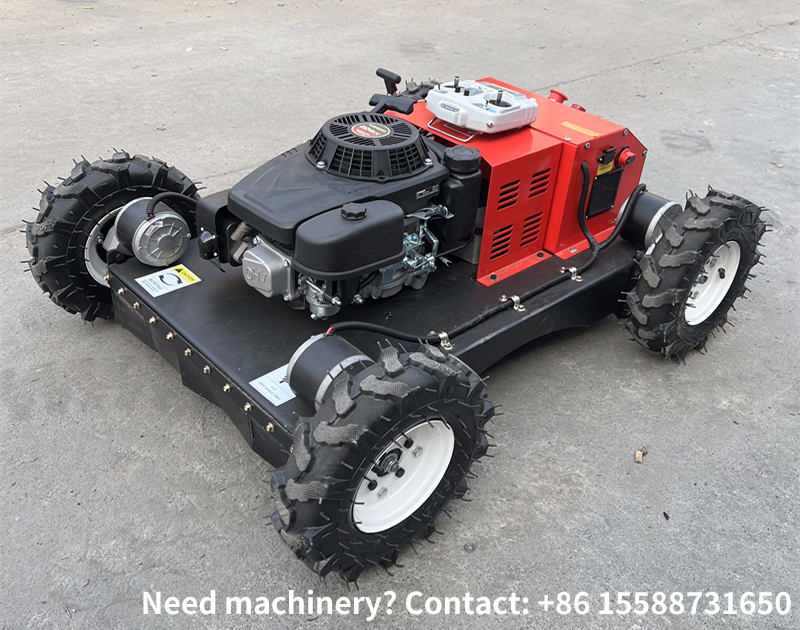
Remote-Controlled Lawn Mower: Operated remotely via a wireless remote control or mobile app. The operator does not need to follow the equipment and can complete mowing work in a safe area. Some high-end models support GPS path planning, automatic mowing, and automatic return for charging.
Push Lawn Mower: Relies entirely on manual pushing to move forward, with manual control of direction and mowing height. The operator must follow the equipment throughout the operation.
Ride-On Lawn Mower: The operator needs to sit on the equipment to drive it, controlling movement and mowing actions through mechanical structures such as a steering wheel and gear shift.
Applicable Scenarios
Remote-Controlled Lawn Mower: Highly adaptable to complex terrains, especially suitable for steep slopes (the climbing angle of some models can reach 30°–45°), narrow areas, irregularly shaped lawns, and orchard row spacing—scenarios where manual access is difficult or safety risks exist. It is applicable to both household and small-scale commercial scenarios.
Push Lawn Mower: Limited to flat, small-sized lawns, such as small green spaces in courtyards. It is not suitable for steep slopes or large-area mowing tasks.
Ride-On Lawn Mower: Ideal for flat, large open lawns, such as golf courses and large manors. It lacks flexibility in narrow areas or on steep slopes.
Work Efficiency
Remote-Controlled Lawn Mower: Features a medium mowing width (30–50 cm for household models, over 80 cm for industrial-grade ones). No manual following is required, enabling continuous operation. Efficiency is further enhanced when equipped with automatic path planning. Small-sized models are more efficient than push lawn mowers, while large industrial models are comparable to ride-on types.
Push Lawn Mower: Has the smallest mowing width (20–30 cm). Manual pushing results in slow speed and the lowest efficiency, making it only suitable for small-area mowing.
Ride-On Lawn Mower: Boasts the largest mowing width (100–200 cm) and high traveling speed, delivering the highest efficiency for large-area operations. However, it has poor flexibility in transferring between sites and turning.
Labor Cost and Physical Consumption
Remote-Controlled Lawn Mower: Involves extremely low physical exertion. One person can operate multiple units simultaneously, resulting in the lowest labor cost. It is particularly suitable for long-duration mowing tasks or operations on complex terrains.
Push Lawn Mower: Requires the maximum physical effort, as the operator has to bend over and push the mower continuously. Working time is limited, leading to high labor costs.
Ride-On Lawn Mower: Causes moderate physical consumption, but it needs a dedicated operator with certain operational skills, resulting in higher labor costs than remote-controlled lawn mowers.
Functional Configuration and Intelligence Level
Remote-Controlled Lawn Mower: Offers the highest level of intelligence. It is generally equipped with obstacle avoidance sensors, steep slope anti-rollover protection, automatic rain shelter, and low-power automatic return functions. Some models support IoT-based remote monitoring.
Push Lawn Mower: Has the most basic functions, only including core mowing and height adjustment features. It has no intelligent configurations and relies entirely on manual operation.
Ride-On Lawn Mower: Features a mechanized-oriented configuration, with functions such as gear adjustment, speed control, and wide-width mowing. Some high-end models are equipped with simple fault alarms, but their intelligence level is far lower than that of remote-controlled lawn mowers.
Supplementary: Cost Differences
Purchase Cost: Push Lawn Mower < Remote-Controlled Lawn Mower < Ride-On Lawn Mower
Usage Cost: Push Lawn Mower (no battery/low fuel consumption) ≈ Remote-Controlled Lawn Mower (low electricity cost for electric models, medium fuel consumption for gasoline-powered ones) < Ride-On Lawn Mower (high fuel consumption and maintenance cost)