In asphalt pavement construction, the initial rolling, intermediate rolling, and final rolling performed by road rollers are three closely linked key processes with distinct objectives, together determining the final quality of the pavement.
Stabilization and Forming: At the highest temperature of the asphalt mixture, achieve rapid stabilization through preliminary compaction to form an initial structural layer with certain strength.
Providing a Benchmark: Offer a flat and solid working foundation for subsequent intermediate and final rolling.
Preventing Shoving: Before the mixture fully cools and hardens, reduce the possibility of shoving and bumping during subsequent rolling through preliminary compaction.
Rolling Timing: Must start after asphalt mixture paving and before the temperature drops to 120°C - 150°C (specific temperature depends on asphalt grade and ambient temperature).
Rolling Method: Adopt static compaction or low-amplitude vibration mode. The road roller should roll from the lower side to the higher side of the pavement, i.e., from edge to center. Rolling speed should be slow, usually 2 - 3 km/h. During rolling, the drive wheels of the road roller should face the paver to minimize shoving of the hot mixture. Rolling passes generally range from 1 to 2.
Quality Control: After initial rolling, the pavement should be basically flat with no obvious shoving or loosening. At this time, the pavement compaction degree should reach 70% - 80% of the design value.
Improving Compaction Degree: This is the most critical step in the entire compaction process. Through high-intensity rolling, the asphalt mixture achieves the design-required compaction degree.
Uniform Compaction: Ensure uniform compaction degree across all parts of the pavement.
Eliminating Wheel Tracks: Remove any wheel tracks possibly left during initial rolling and further level the pavement.
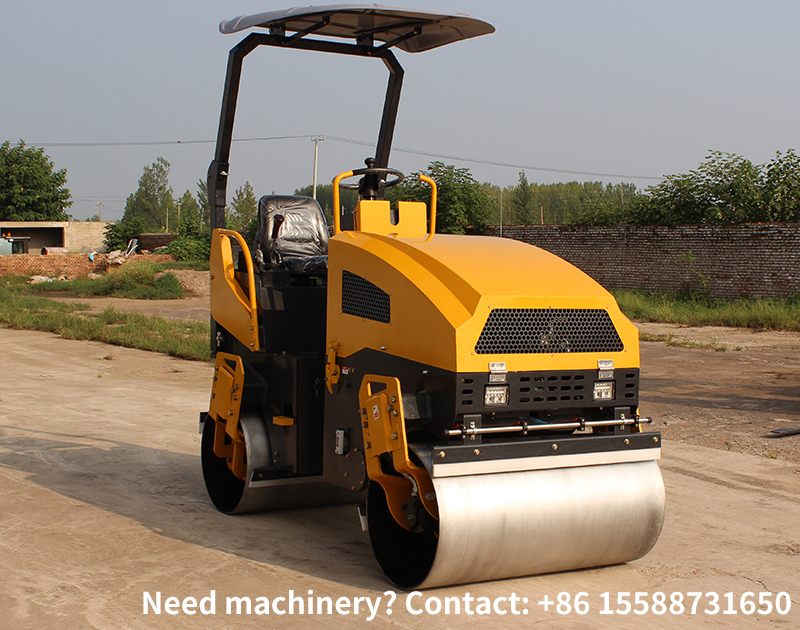
Road Roller Type: Double-drum vibratory road rollers are the main equipment for intermediate rolling, usually using high-amplitude and high-frequency vibration modes. Pneumatic tire rollers are also widely used in intermediate rolling; their kneading effect can effectively improve compaction degree and uniformity.
Rolling Timing: Conduct immediately after initial rolling, when the temperature of the asphalt mixture is usually between 90°C - 120°C.
Rolling Method: Vibration rolling (double-drum) or kneading rolling (pneumatic tire roller) can be adopted. Rolling speed can be appropriately increased, usually 3 - 5 km/h. Rolling passes are the most, generally 4 - 6, with specific passes determined by road roller type, tonnage, and mixture characteristics. During rolling, adjacent rolling strips should overlap 1/3 - 1/2 of the wheel width to ensure uniform compaction.
Quality Control: After intermediate rolling, the pavement compaction degree should reach or approach the design value. The pavement should be flat, dense, with no obvious wheel tracks or loosening.
Eliminating Wheel Tracks: Completely remove any wheel tracks left during intermediate rolling to ensure the final flatness of the pavement.
Precision Leveling and Forming: Perform final fine leveling on the pavement to meet the design-required flatness standards.
Ensuring Surface Quality: Ensure the pavement surface is smooth and defect-free to improve driving comfort and pavement durability.
Road Roller Type: Smooth-drum road rollers are the preferred equipment for final rolling, usually using heavy-duty smooth-drum road rollers. Pneumatic tire rollers can also be used for final rolling, but their kneading effect may affect the final surface flatness, so caution is needed when using.
Rolling Timing: Conduct after intermediate rolling, when the temperature of the asphalt mixture has usually dropped to 70°C - 90°C.
Rolling Method: Must adopt static compaction mode; vibration is strictly prohibited. Rolling speed can be appropriately increased, usually 3 - 6 km/h. Rolling passes generally range from 1 to 2. During rolling, the road roller should eliminate wheel tracks as much as possible; transverse rolling can be performed if necessary.
Quality Control: After final rolling, the pavement should be flat, smooth, with no wheel tracks, cracks, loosening, or shoving. Final indicators such as pavement compaction degree, flatness, and texture depth should meet design and specification requirements.
The entire rolling process is a continuous operation. Strict control over road roller selection, combination, rolling temperature, speed, passes, and method is essential to ensure the construction quality of asphalt pavement.


 Chinese