

 Chinese
- HOME >> NEWS >> Industry news
NEWS
Latest Product
Contact Us
How to Choose Between Single-Drum and Double-Drum Rollers?
2025-04-24The choice between a single-drum roller and a double-drum roller depends on factors such as material type, construction phase, and site conditions. Below is a detailed comparison and selection guide.
I. Key Differences
| Feature | Single-Drum Roller | Double-Drum Roller |
|---|---|---|
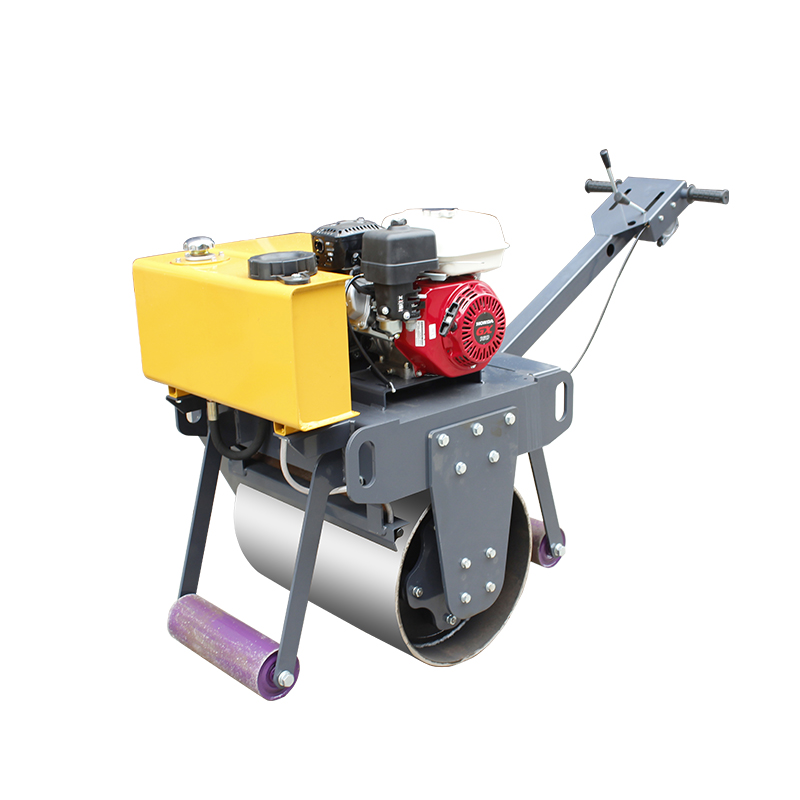
| Structure | Front steel drum + rear tires (or all-steel) | Front and rear steel drums (no tires) |
| Compaction Principle | High linear pressure (weight + impact force) | Even surface pressure (dual-drum synergy) |
| Primary Use | Deep compaction (subgrade, gravel, clay) | Surface compaction (asphalt, thin layers) |
| Vibration | High amplitude (1.5–2mm), low frequency (25–30Hz) | Low amplitude (0.3–0.8mm), high frequency (40–50Hz) |
| Efficiency | Greater depth but slower (2–5 km/h) | Faster (3–8 km/h), ideal for continuous work |
| Surface Finish | May leave marks, requires finishing | Smooth, seamless finish |
II. Selection Guidelines
1. Prefer Single-Drum Rollers for:
Deep Compaction Needs
Subgrade fill, gravel mixtures (compaction depth ≥30cm).
High-moisture clay (requires high amplitude to break clumps).
Large-Scale Earthwork
Mines, embankments needing high impact force.
Budget Constraints
Single-drum models are typically 20–30% cheaper than double-drum.
2. Prefer Double-Drum Rollers for:
Asphalt Pavement
Surface layers (especially SMA, OGFC modified asphalt).
Thin-layer paving (<5cm) requiring high-frequency vibration.
High Surface Quality
Municipal roads, airport runways needing seamless finishes.
Confined Spaces
Some models narrow to 1.2m (e.g., tunnel work).
III. Adaptations for Special Conditions
Slope Compaction
Single-drum: Requires anti-slip tires/cleats (max slope ≤20%).
Double-drum: Can compact longitudinally (disable front vibration to prevent slippage).
Transition Zones
Base layer (single-drum) → asphalt layer (double-drum) combo.
Vibration-Sensitive Areas
Double-drum: Can deactivate one drum’s vibration.
Single-drum: Must reduce amplitude.
IV. Cost Considerations
Single-Drum: Lower maintenance (simpler structure), but asphalt work may require additional pneumatic roller for finishing.
Double-Drum: Higher upfront cost but eliminates need for finishing equipment, ideal for professional asphalt crews.
V. Recommended Equipment Combinations
| Construction Phase | Recommended Setup |
|---|---|
| Subgrade compaction | Single-drum (18–25 tons) + impact roller |
| Asphalt base layer | Single-drum (10–12 tons) + pneumatic roller |
| Asphalt surface layer | Double-drum (8–14 tons, high-frequency/low amplitude) |
| RCC (roller-compacted concrete) | Single-drum (high amplitude) + double-drum (finishing) |
Conclusion
Choose Single-Drum: For earthwork, gravel, and deep compaction where cost efficiency matters.
Choose Double-Drum: For asphalt, thin-layer finishing where surface quality is critical.
Complex Projects: Combine both (e.g., single-drum for subgrade, double-drum for surface).