


What Are the Precautions for Excavator Travel Operation?

2025-09-18

The travel operation of an excavator is a key link to ensure equipment safety, efficiency, and service life. It needs to be carried out around four core dimensions: environment judgment, operation specifications, equipment protection, and safety protection. The specific precautions can be divided into the following categories:

1. Before Travel: Mandatory Inspection and Environment Assessment

Preparation work before travel directly avoids subsequent risks, and the following items must be confirmed one by one:

Equipment Status Inspection

  • Check Tracks/Tires: For tracked excavators, confirm the tightness of track shoes (too loose may cause derailment, too tight increases wear) and the lubrication of track pins. For wheeled excavators, check tire pressure and tread wear (avoid driving on roads with sharp gravel).

  • Check Travel System: After starting the excavator, test the left and right travel levers to confirm that there is no abnormal noise from the travel motor and reducer (a "clunking" sound may indicate a gear failure), and that the braking system is sensitive (the equipment does not roll when in neutral).

  • Check Auxiliary Components: Verify that the levels of fuel, hydraulic oil, and coolant are normal, and that the cab seat belt, rearview mirrors, and travel indicator lights are in good condition.

Environment and Route Planning

  • Survey Ground Conditions: Avoid soft ground (such as mud and quicksand). If passage is necessary, lay steel plates or gravel. Avoid steep slopes (the maximum climbing angle of tracked excavators is usually ≤35°, and that of wheeled excavators is ≤25°; exceeding the angle may cause rollover).

  • Clear Route Obstacles: Remove stones, pipelines, trees, etc., from the travel path to prevent tracks/tires from being stuck or underground facilities from being damaged. For nighttime travel, confirm that the lighting system is normal and that there are no blind spots in the route.

2. During Travel: Core Operation Specifications (Divided by Tracked/Wheeled Types)

Excavators with different travel structures have different operating logics, and targeted compliance with specifications is required to avoid equipment damage or safety accidents caused by misoperation:


TypeCore Operation Precautions
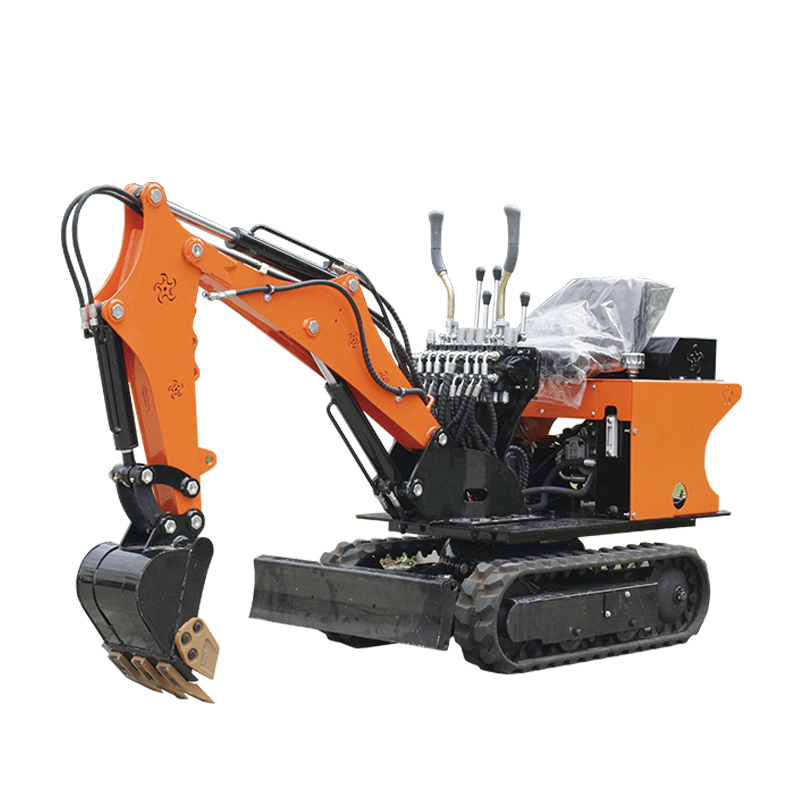
Tracked Excavators1. Steering Operation: First reduce the travel speed, and realize steering by "stopping/reversing one side of the track" (high-speed sharp turns are prohibited, otherwise track shoes may break and drive wheel teeth may wear).
2. Straight Travel: Ensure that the left and right travel levers are pushed/pulled to the same extent to avoid one-sided deviation (long-term deviation will cause uneven load on the travel motor).
3. Crossing Obstacles/Climbing Slopes: When climbing, the center of gravity shifts backward; the front section of the track should go up first, followed by the rear section. Oblique climbing is prohibited (it may cause rollover). When descending slopes, use low gear and rely on engine resistance for braking (avoid frequent braking to prevent brake overheating and failure).
Wheeled Excavators1. Driving Mode Switching: Use "high gear" for highway driving and "low gear" for rough construction site roads (high gear on bumpy roads is prohibited to avoid damage to the shock absorption system).
2. Steering and Braking: Decelerate when steering (similar to cars; high-speed steering may cause skidding). For emergency braking, step on both the service brake and parking brake at the same time (avoid relying solely on the service brake to prevent brake pad wear).
3. Tire Protection: Avoid rolling over sharp objects (such as steel bars and gravel). When passing potholes, let one side of the wheels pass slowly (simultaneous trapping of both wheels is prohibited to prevent frame deformation).

5.jpg

3. Special Scenarios: Additional Precautions

Travel in Narrow Spaces

  • Measure the width of the space in advance (a gap of ≥30cm should be reserved for tracked excavators, and ≥50cm for wheeled excavators), and use "inching operation" to control the travel speed (avoid pushing the lever to the maximum at once to prevent collisions).

  • If reversing is required, someone must direct at the rear (or turn on the reversing image and alarm); blind reversing is prohibited.

Mounting/Dismounting Flatbed Trucks (Transport Scenarios)

  • The flatbed truck must be fixed stably (place triangular wooden blocks to prevent rolling). When the excavator travels, "lower the bucket to the ground and slightly lift the boom" (keep the bucket 20-30cm above the ground to play a balancing role).

  • When going up or down the slope, the excavator body must be perpendicular to the flatbed truck ramp (oblique mounting/dismounting is prohibited to avoid rollover). After fully mounting the truck, fix the tracks/tires with steel cables (select the load-bearing part of the frame as the fixed point, not the travel motor).

Wading Travel

  • First confirm the water depth (the water depth for tracked excavators should be ≤1/2 of the track height, and ≤1/3 of the tire height for wheeled excavators; submerging the travel motor or hydraulic pipelines is prohibited).

  • Pass through water at a low and constant speed (avoid splashing water into the engine air intake). After landing, idle the travel motor (to drain internal water and prevent rusting).

4. Safety and Maintenance: Long-Term Precautions

Personnel Safety

  • Prohibit personnel from standing on both sides of the tracks/tires during travel (to avoid pinching by track links or rolling by tires).

  • Fasten the seat belt in the cab, and prohibit operating the bucket while traveling (such as excavating while moving, which may cause the equipment to lose balance).

Equipment Maintenance Relevance

  • After travel, clean up foreign objects (such as stones and weeds) on the tracks/tires to prevent jamming of travel components.

  • Check the temperature of the travel motor after long-term travel (the normal temperature is ≤60℃; if it is too hot, stop the machine to check whether the hydraulic oil is insufficient or the motor is faulty).

  • Regularly lubricate travel pins and bearings (lubricate tracked excavators every 50 hours, and check the hub bearing grease of wheeled excavators every 100 hours).


In summary, the core principle of excavator travel operation is "start slowly, operate steadily, evaluate first, and prevent risks". Adjustments should be made flexibly according to the equipment type and environmental conditions, while taking into account safety specifications and equipment protection to avoid failures or accidents caused by improper operation.


Would you like me to sort out a simplified English checklist for excavator travel safety based on this translated content, so you can quickly verify key precautions before and during operation?

6.jpg

Online Message