

 Chinese
- HOME >> NEWS >> Industry news
NEWS
Latest Product
Contact Us
How to Choose the Right Road Roller for Different Compaction Materials
2025-05-08The selection of a road roller primarily depends on factors such as material type, construction requirements, and environmental conditions. Below is a guide for choosing the appropriate roller based on different compaction materials:
Asphalt Mixture (Asphalt Pavement)
Compaction Requirements: High density, smoothness, and prevention of aggregate breakage.
Recommended Rollers:
Initial Compaction (High-Temperature Stage): Double-drum vibratory roller (high frequency, low amplitude to prevent material displacement).
Intermediate Compaction (Medium-Temperature Stage): Pneumatic-tired roller (kneading action improves density).
Final Compaction (Low-Temperature Stage): Static double-drum roller (eliminates wheel marks, enhances smoothness).
Avoid: Impact rollers (may damage asphalt structure).
2. Sandy Soil, Gravel, Crushed Stone (Granular Materials)
Compaction Requirements: Deep compaction to improve load-bearing capacity.
Recommended Rollers:
Sandy/Silty Soil: Vibratory roller (single or double drum, medium-to-high amplitude).
Gravel/Crushed Stone:
Small/medium particles: Vibratory roller (high-frequency vibration for particle interlocking).
Large particles (e.g., rock fill): Impact roller (strong impact for deep compaction).
Avoid: Pneumatic-tired rollers (may displace particles).
3. Cohesive Soil (Clay, Silt)
Compaction Requirements: Overcome cohesion, prevent "springy soil."
Recommended Rollers:
Light Clay: Pneumatic-tired roller (kneading improves density).
Heavy Clay: Sheepsfoot roller (protrusions break clumps for better compaction).
High-Moisture Clay: Dry or mix with lime first, then use a vibratory roller.
Avoid: High-frequency vibratory rollers (may cause soil liquefaction).
4. Stabilized Soil (Cement/Lime-Stabilized Soil)
Compaction Requirements: Uniform compaction to prevent cracking.
Recommended Rollers:
Initial Compaction: Static roller (prevents material displacement).
Intermediate Compaction: Vibratory roller (medium-low amplitude for density).
Final Compaction: Pneumatic-tired roller (reduces cracks, improves surface quality).
5. Special Materials (Frozen Soil, Desert Sand, Landfill)
Frozen Soil: Impact roller (breaks frozen layers for better compaction).
Desert Sand: Vibratory roller + water sprinkling (increases interparticle friction).
Landfill: Heavy vibratory or padfoot roller (enhances compression).
6. Narrow Areas (Trenches, Sidewalks)
Recommended Rollers:
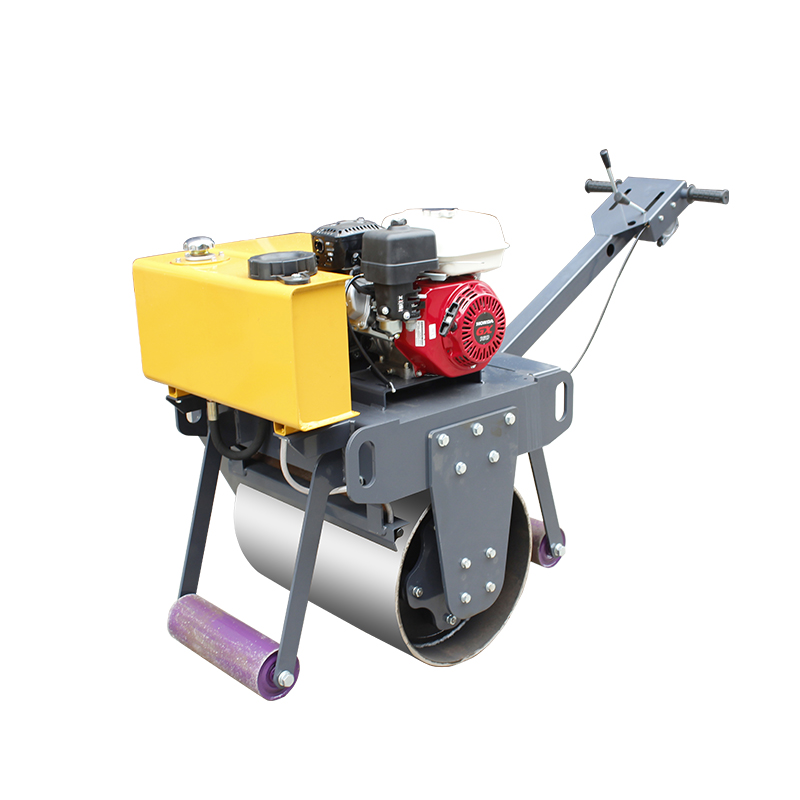
Walk-behind mini roller (1–3 tons).
Plate compactor (for corners and edges).
Key Selection Factors
| Factor | Considerations |
|---|---|
| Material Type | Different rollers for asphalt, sandy soil, clay, etc. |
| Compaction Depth | Thin layers (static/pneumatic), thick layers (vibratory/impact). |
| Environment | Narrow spaces (mini rollers), sensitive areas (low-noise/static). |
| Efficiency | Large projects (heavy rollers), small projects (walk-behind). |
| Eco-Friendliness | Low noise (static), fuel efficiency (electric/hybrid). |
Conclusion
Asphalt Pavement → Double-drum vibratory + pneumatic combination.
Gravel/Stone Subgrade → Single-drum vibratory/impact roller.
Cohesive Soil → Pneumatic/sheepsfoot roller.
Narrow Areas → Walk-behind roller.
Choosing the right roller improves compaction quality, reduces costs, and extends equipment lifespan.