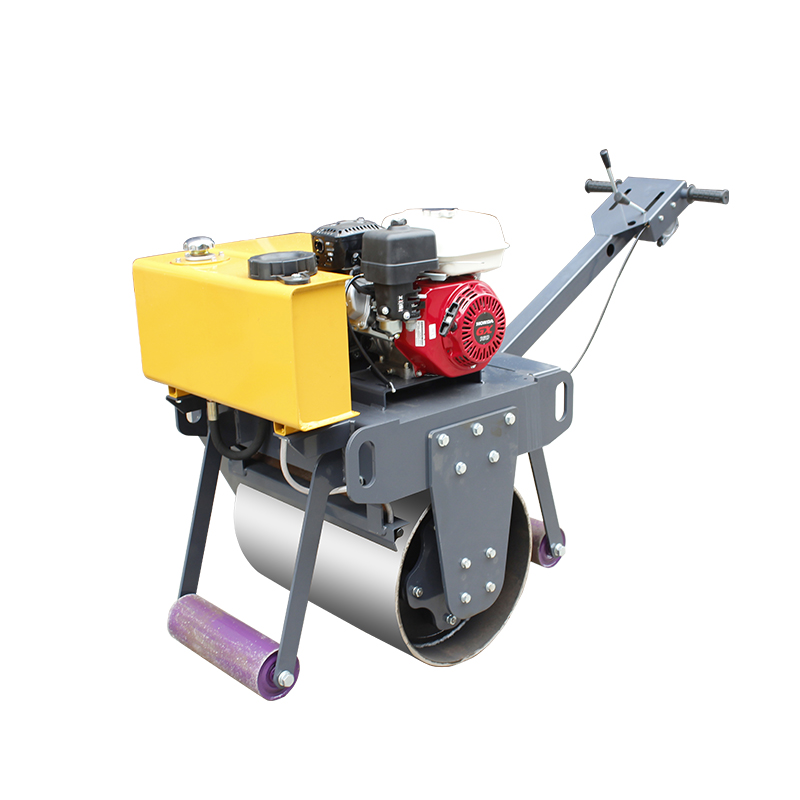
The compaction effect of a road roller is crucial to ensuring the quality of foundation projects such as roads and sites, and it is comprehensively affected by various factors. The relevant factors are analyzed in detail below from multiple dimensions including mechanical parameters, material properties, and construction techniques:
Type of compaction machinery
Different types of road rollers have different working principles, and their applicable scenarios and compaction effects vary significantly:
Static action roller: Compacts by its own weight, suitable for thin layers or materials with low water content, with a shallow compaction depth.
Vibratory roller: Rearranges material particles through high-frequency vibration, with a large compaction depth and high efficiency, suitable for earth-rock subgrades, etc.
Impact roller: Compacts materials with periodic impact loads, can handle deep loose soil, and enhance foundation stability.
Weight and linear pressure of the road roller
The greater the weight, the greater the pressure on the material (linear pressure is positively correlated with weight), but it needs to match the material properties: too light may result in insufficient compaction, and too heavy may cause shear damage to the subgrade (such as cohesive soil being "pushed over").
Vibration parameters (for vibratory rollers)
Amplitude: Affects vibration intensity and compaction depth; large amplitude is suitable for deep compaction, and small amplitude is suitable for surface finishing.
Frequency: Related to the resonance frequency of the material (e.g., sand is suitable for high frequency, cohesive soil for low frequency); the best compaction effect is achieved when matched.
Material type
Sand: Dominated by friction between particles, requiring vibration compaction to reduce pores.
Cohesive soil: Relies on static pressure to squeeze out water and air, with poor vibration effect, and water content needs to be controlled.
Earth-rock mixture: Needs to match the roller's power and vibration parameters to avoid particle separation.
Water content
Too low water content: Large friction between material particles, difficult to compact, and high porosity.
Too high water content: The material is in a plastic state, prone to the "spring" phenomenon (rebound under pressure), and strength drops sharply.
Optimal water content: At this point, the material has the highest compaction degree (determined by compaction tests).
It is a core factor affecting the compaction effect.
Particle gradation
Well-graded materials (reasonable matching of coarse and fine particles) have low porosity and good stability after compaction.
Poorly graded materials (such as uniform sand) are prone to pore concentration and poor compaction effect.
Paving thickness
The paving thickness of each layer must match the compaction capacity of the roller: too thick will lead to "solid on top and loose at the bottom" with insufficient deep compaction; too thin will result in low efficiency and high cost (usually determined according to the roller type, e.g., vibratory rollers are generally controlled at 30-50cm).
Number of compaction passes
In the initial stage, the compaction degree increases significantly with the number of passes; after a certain number of passes, the compaction degree tends to be stable (optimal number of passes); excessive rolling may damage the material structure (such as shear failure of cohesive soil).
Rolling speed and driving route
Too fast speed: Short contact time between the roller and the material, insufficient compaction energy.
Too slow speed: Low efficiency, may cause local over-compaction.
The route should follow the principle of "from low to high, from edge to center" (to avoid pushing materials), and overlapping rolling (overlap width is usually 1/3-1/2 of the wheel width) to ensure no missed compaction areas.
Rolling temperature (for asphalt pavements)
Asphalt mixtures must be rolled within the specified temperature range (different temperatures for initial, re-, and final rolling): too low temperature makes asphalt highly viscous and difficult to compact; too high temperature is prone to pushing and bleeding.
Temperature: Low temperature will reduce the plasticity of materials (e.g., cohesive soil cannot be compacted after freezing), and high temperature may cause asphalt mixtures to cool too quickly.
Humidity: Rainy days or accumulated water in the foundation will increase the water content of materials, requiring suspension of construction and handling of accumulated water.
Foundation bearing capacity: If the underlying layer is weak, it may cause the roller to get stuck, affecting the compaction effect of the upper layer, and the foundation must be treated first.
The compaction effect of a road roller is the result of the synergistic effect of mechanical parameters, material properties, and construction technology. In actual construction, it is necessary to determine the optimal parameters (such as water content, number of compaction passes, paving thickness, etc.) through test sections and dynamically adjust them according to on-site conditions to meet the designed compaction degree and engineering quality requirements.



 Chinese