

 Chinese
- HOME >> NEWS >> Industry news
NEWS
Latest Product
Contact Us
How to Improve the Compaction Efficiency of Road Rollers?
2025-07-18Improving the compaction efficiency of road rollers can save time and fuel costs while ensuring construction quality. Below are key methods to enhance compaction efficiency:
1. Selecting the Right Type of Road Roller
Choose the model based on material:
Asphalt pavement: Prioritize double-drum vibratory rollers (high-frequency vibration improves density).
Soil/gravel base layers: Use pneumatic tire rollers (flexible compaction) or single-drum vibratory rollers (strong impact force).
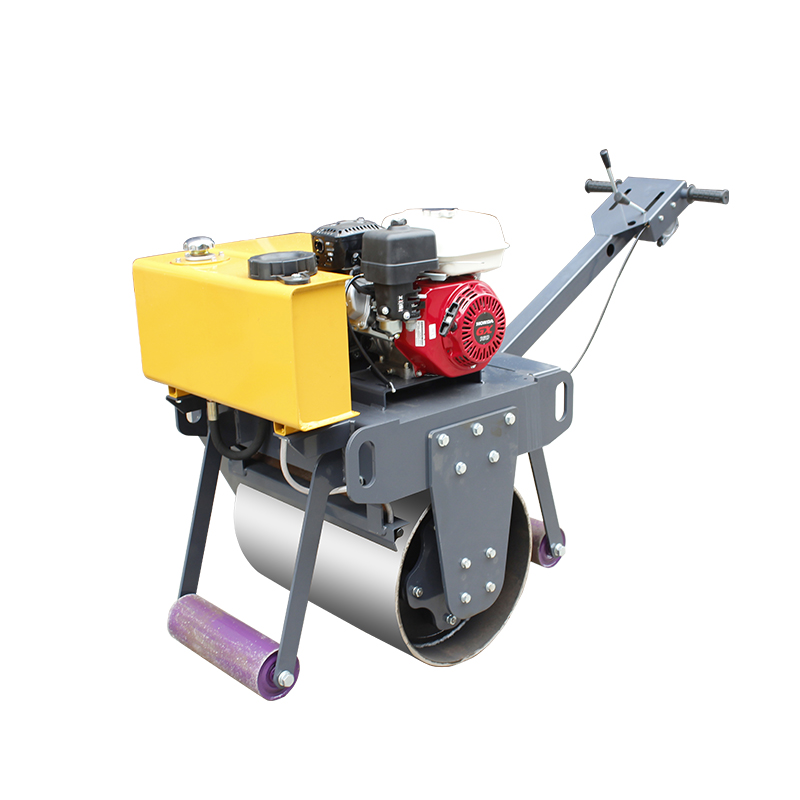
Narrow areas: Opt for small walk-behind rollers or combination rollers.
Match tonnage and amplitude:
For thick soil layers or coarse materials (e.g., crushed stone), use high-tonnage + high-amplitude rollers.
For thin asphalt layers or fine-grained soil, use low-amplitude + high-frequency rollers to avoid material breakage.
2. Optimizing Operation Techniques
Control rolling speed:
Optimal speed range: 2–6 km/h (typically 3–5 km/h for vibratory rollers).
Excessive speed leads to uneven compaction, while too slow reduces efficiency.
Plan rolling paths scientifically:
Initial pass (static or low amplitude) → Intermediate pass (high-amplitude vibration) → Final pass (eliminate wheel marks).
Follow the "light first, heavy later; slow first, fast later" principle.
Overlap rolling: Each pass should overlap 1/3 to 1/2 of the wheel width to avoid missed spots.
Adjust vibration settings:
High-frequency vibration (e.g., above 50Hz) suits surface compaction, while low-frequency, high-amplitude (e.g., 25–30Hz) is better for deep compaction.
Turn off vibration during the final pass on asphalt to prevent surface loosening.
3. Material and Environmental Management
Control moisture content:
Test soil moisture before compaction; efficiency is highest near the optimum moisture content (typically within ±2%).
Dry overly wet soil or sprinkle water if too dry.
Compact in layers:
Each layer should not exceed the roller’s effective compaction depth (e.g., 20–30 cm) to avoid "false compaction."
Excessive thickness leads to insufficient lower-layer density.
Consider ambient temperature:
Asphalt compaction: Complete initial rolling above 110°C; increase speed or roller numbers in cold weather.
Frozen soil or rainy days: Avoid work, as excessive moisture reduces compaction effectiveness.
4. Equipment Maintenance and Adjustments
Regularly maintain key components:
Inspect vibratory drum bearings, hydraulic systems, and engine condition to ensure stable power output.
Replace worn tires or steel wheels promptly to prevent slippage.
Adjust tire pressure (for pneumatic rollers):
Maintain uniform tire pressure for even ground contact pressure.
5. Auxiliary Technology Applications
Use intelligent compaction technology:
Rollers equipped with GPS and compaction sensors monitor density in real time, avoiding over-compaction.
Multi-machine coordination:
On large projects, combine different roller types (e.g., pneumatic + steel-wheel) for higher overall efficiency.
Conclusion
Efficiency can be significantly improved by selecting the right equipment, standardizing operations, controlling materials, and maintaining machinery. For example, in asphalt pavement construction, using high-frequency vibratory rollers + layered compaction + temperature control can reduce project time by over 30% compared to traditional methods.