

 Chinese
- HOME >> NEWS >> Industry news
NEWS
Latest Product
Contact Us
How Does the Vibration System of a Road Roller Affect Compaction Effectiveness? What Are the Differences Between Frequency and Amplitude?
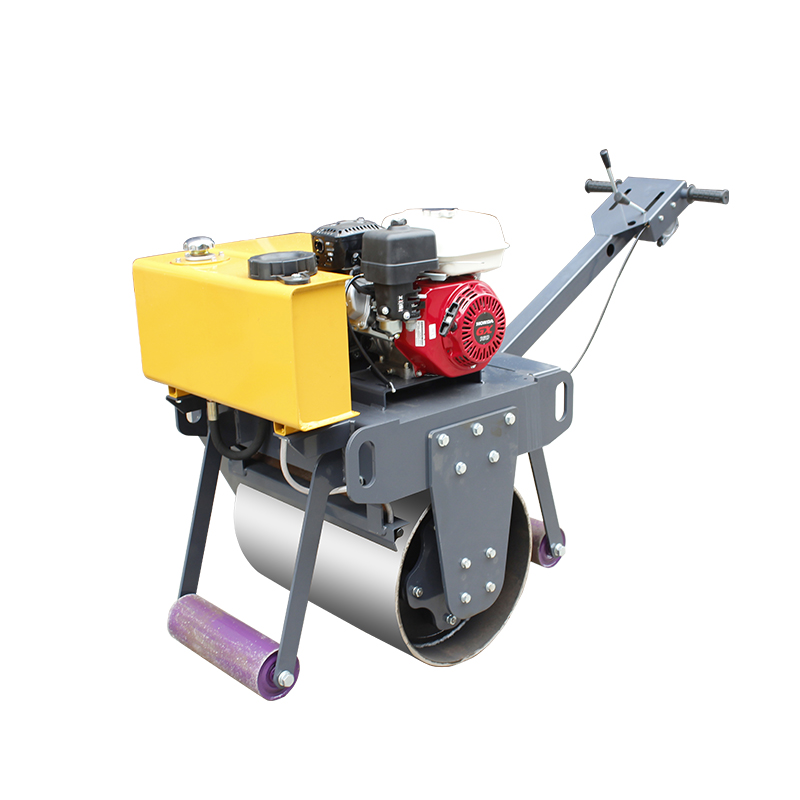
2025-05-15The vibration system of a road roller is a core factor determining compaction effectiveness. It generates periodic vibrations through the vibrating drum to impact soil or asphalt, reducing voids between particles and increasing density. The selection of vibration frequency and amplitude directly influences compaction efficiency and quality.
How Does the Vibration System Affect Compaction Effectiveness?
Enhances particle rearrangement: Vibrational forces cause material particles (e.g., soil, asphalt) to shift and compact, reducing porosity.
Increases compaction depth: Vibration waves penetrate deeper layers, ideal for thick-layer compaction (e.g., subgrade filling).
Reduces the number of passes needed: Compared to static rolling, vibratory rollers shorten construction time and improve efficiency.
Adapts to diverse materials: Adjustable vibration modes suit granular soils, clay, asphalt mixes, etc.
2. Impact of Vibration Frequency (Hz)
Vibration frequency refers to the number of vibrations per second (Hz, typically 25–50 Hz):
High frequency (30–50 Hz):
Ideal for surface compaction (e.g., asphalt pavements), ensuring rapid and uniform densification.
Reduces surface cracking risks and improves smoothness.
Low frequency (25–30 Hz):
Suitable for deep-layer compaction (e.g., subgrades, fill soils), transmitting energy to greater depths.
May loosen surface material, requiring supplementary static or high-frequency compaction.
3. Impact of Amplitude (mm)
Amplitude refers to the vertical displacement of the vibrating drum (mm, typically 0.3–2.0 mm):
High amplitude (1.5–2.0 mm):
Delivers strong impact forces, ideal for thick layers or coarse-grained materials (e.g., gravel, crushed stone bases).
Risks over-disturbing fine-grained materials (e.g., clay), causing uneven surfaces.
Low amplitude (0.3–1.0 mm):
Suitable for thin layers (e.g., asphalt surface courses) or fine materials (e.g., sandy soils), preventing particle breakdown.
Provides uniform compaction and reduces "over-compaction" risks.
4. Synergistic Effects of Frequency and Amplitude
High frequency + low amplitude: Used for final compaction of asphalt pavements to enhance density and smoothness.
Low frequency + high amplitude: Applied in subgrade or embankment projects to ensure deep-layer stability.
Intelligent adjustment: Modern rollers automatically adapt frequency/amplitude to material layers.
5. Practical Application Guidelines
Asphalt compaction: Prioritize high frequency (40–50 Hz) + low amplitude (0.4–0.8 mm).
Soil compaction: Use low frequency + medium amplitude for clay and high frequency + high amplitude for sandy gravel.
Field trials: Conduct test sections to optimize vibration parameters before full-scale construction.
Summary: The vibration system’s frequency and amplitude must be optimized based on material type, layer thickness, and project requirements. Proper combinations can enhance compaction efficiency and avoid quality defects (e.g., over-compaction, surface loosening, or cracking).