

 Chinese
- HOME >> NEWS >> Industry news
NEWS
Latest Product
Contact Us
Which is Easier for Operators to Learn: Wheel Excavators or Crawler Excavators?
2025-10-11Compared with crawler excavators, wheel excavators are easier for operators to learn. The core reason lies in the significant differences between the two types of equipment in terms of driving control logic, operating feel, and alignment with "conventional driving cognition". The specific analysis can be carried out from two aspects: core operational differences and learning thresholds.
I. Core Operational Differences: Wheel Excavators Align More with "Daily Driving", While Crawlers Require Adapting to Special Logic
The "operational control" logic (such as bucket lifting/lowering, boom extension/retraction, and body slewing) of the two types of excavators is consistent—both control the hydraulic system through joysticks, and new operators only need to learn this part uniformly. The core difference lies in "driving control", which is the key threshold for new operators to get started:
The driving control of wheel excavators is exactly similar to that of cars or loaders: a steering wheel is used to control steering, an accelerator pedal to control forward speed, and a brake pedal to control deceleration/stopping. Some models also have a "high-speed/low-speed gear" switch (high-speed gear for transferring between work sites, low-speed gear for fine adjustments during operations). This control logic highly aligns with the habit of "driving a car" in daily life. New operators hardly need to establish new cognitive patterns and can quickly adapt to switching between "driving" and "operating".
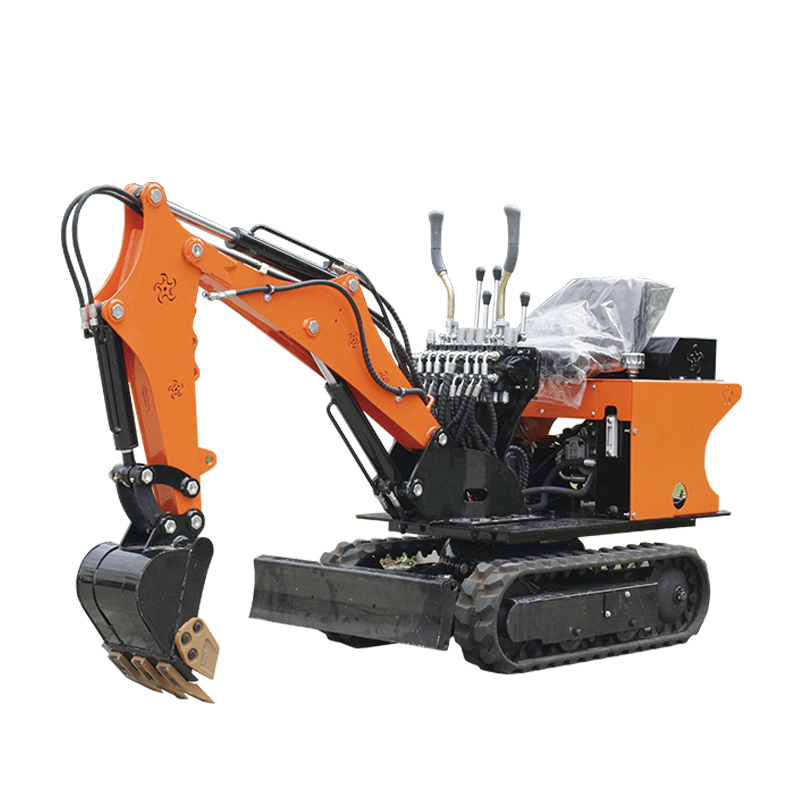
Crawler excavators do not have a steering wheel; instead, they rely on independent control of the left and right crawlers: the left joystick controls the forward/backward movement of the left crawler, and the right joystick controls the forward/backward movement of the right crawler. For example, to turn left, it is necessary to "move the left crawler backward + move the right crawler forward"; to turn right, the opposite is required. Even for in-place turns, the left and right crawlers need to "rotate in opposite directions". This "dual-joystick independent control" logic is completely different from conventional driving. New operators tend to experience "excessive steering or body deviation" in the early stages and need repeated practice to master the synchronization of the crawlers and the steering range.
II. Learning Threshold: Wheel Excavators Offer "Smooth Transition", While Crawlers Require Breaking "Operational Inertia"
The main difficulty for new operators learning to use excavators essentially lies in "breaking or adapting to operational habits different from conventional driving", and the design of wheel excavators greatly reduces this "habit conflict":
The learning path for wheel excavators is shorter: if a new operator has driving experience with wheeled vehicles such as cars or loaders, they can almost directly master the driving control of wheel excavators. They only need to additionally learn the use of "operational joysticks"—which is equivalent to "adding a set of skills for 'controlling the bucket' on the basis of familiar driving". The logic is coherent and not easily confusing. Usually, new operators can initially master the coordination of "driving + simple operations" within 1-2 days.
Crawler excavators require re-establishing operational inertia: even if a new operator can drive a car, they must start from scratch to adapt to the "dual-joystick crawler control" logic. They not only need to remember "the pushing/pulling direction of the left and right joysticks when steering" but also balance "driving speed and body stability". Crawlers do not have a suspension system, so the ride is bumpy during driving, and the body is prone to tilting when turning. New operators need to pay attention to both "joystick operation" and "body status", which consumes more attention. It usually takes 3-5 days for them to initially overcome "operational inertia" and avoid frequent operational errors.
In conclusion, whether from the perspective of "alignment between operational logic and daily driving" or "length of the learning path", wheel excavators are more friendly to new operators, and their learning difficulty is significantly lower than that of crawler excavators.