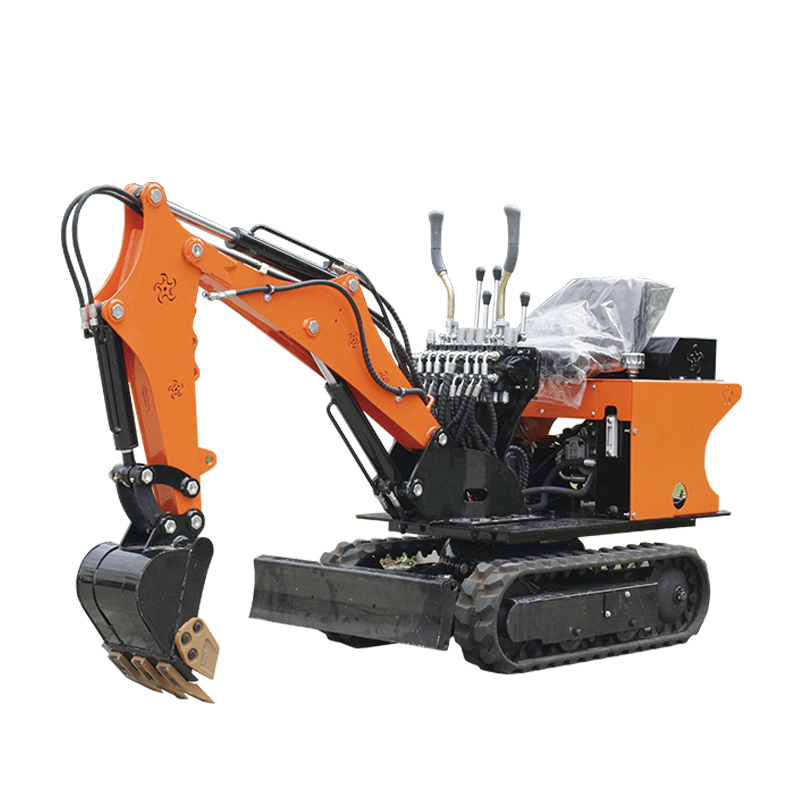
When a tracked excavator operates on sloped terrain, loss of body balance can easily lead to safety accidents such as rollovers and slips. The core control logic is "align with the slope direction, keep the center of gravity centered, maintain low and constant speed, and use the bucket for protection". It is necessary to strictly follow the special operating specifications for uphill and downhill operations, while maintaining balance through precise control of the equipment's posture and force distribution. The specific details are as follows:
Survey the slope in advance to confirm that the slope angle does not exceed the equipment's rated climbing angle (generally, the maximum climbing angle of tracked excavators is 30°-35°; operation beyond the limit is strictly prohibited). Remove obstacles such as gravel and oil stains on the slope to prevent the tracks from slipping.
Check the track tension, braking system, and slewing mechanism to ensure that the support rollers and drive wheels operate normally. At the same time, remove unnecessary attachments from the machine body to reduce non-essential counterweight and avoid deviation of the center of gravity.
Directional driving: Drive the machine body directly facing the slope, with the tracks parallel to the slope direction. Transverse climbing is strictly prohibited (transverse slope force can easily cause rollover). If direction adjustment is needed, first stop the machine body on a gentle part of the slope, make small-angle fine adjustments, and then continue climbing.
Bucket positioning: Turn the bucket teeth downward and gently press them against the ground. Retract the boom slightly and extend the arm fully. Use the bucket for auxiliary support to prevent the machine body from slipping. Lifting the bucket high or leaving it suspended is strictly prohibited, as this will raise the center of gravity.
Speed and power control: Use low gear to drive at a constant speed, and supply fuel steadily through the accelerator. Avoid sudden acceleration and sudden stops. If power is insufficient during climbing, decelerate in advance; do not step hard on the accelerator to prevent the tracks from slipping and idling. If stopping is required, first set the bucket firmly on the ground, then apply the brake to stop the machine.
Slewing prohibition: Slewing operations are strictly prohibited during uphill climbing. Slewing actions will change the distribution of the machine body's center of gravity, disrupt longitudinal balance, and easily cause rollover.
In addition to surveying the slope and checking the equipment, it is necessary to additionally confirm that there are no personnel or obstacles at the bottom of the slope, and reserve sufficient safe buffer space. For long and steep slopes, plan gentle stopping points in the middle of the slope in advance to facilitate segmented downhill movement.
Adjust the machine body's counterweight, and move the movable counterweight to the front of the machine body to increase the ground pressure at the front and prevent the machine body from tilting forward during downhill.
Reverse alignment and bucket forward placement: Drive the machine body directly facing the slope for downhill movement. Extend the bucket forward with the teeth facing downward and close to the ground to form "forward probing protection". Keep the boom and arm slightly bent, and use the friction of the bucket for auxiliary braking to prevent the machine body from accelerating and slipping.
Low-speed braking and neutral gear prohibition: Must engage low gear and rely on the engine's idle speed to restrict the vehicle speed. At the same time, gently step on the brake pedal to control the downhill speed. Sliding in neutral gear is strictly prohibited. Use the "intermittent braking" method when braking; avoid prolonged locked braking to prevent overheating and damage to the tracks.
Machine body posture control: Keep the machine body horizontal and avoid tilting forward or backward. If the slope angle is uneven, adjust the boom slowly to ensure that the tracks bear force evenly. Do not lift or lower the boom sharply.
Personnel standing prohibition: During downhill, personnel are strictly prohibited from standing on both sides and behind the machine body to prevent injuries from stones carried by the tracks or collisions caused by machine body out of control.
Maintain coordination between the boom, arm, and machine body throughout the operation. Avoid overextending, lifting high, or deviating the bucket from the machine body's center line. When excavating, work as much as possible directly in front of the tracks to reduce one-sided force.
Adjust the counterweight distribution and make fine adjustments according to the slope direction: When going uphill, shift the counterweight slightly backward to enhance rear grip; when going downhill, shift the counterweight slightly forward to offset the forward tilting tendency. Ensure that the center of gravity always falls within the track contact range.
During slope operation, adjust the boom slightly to ensure that all support rollers touch the ground, avoiding one-sided track suspension or excessive force. If there are protrusions on the slope, pass them slowly to prevent the machine body from tilting due to concentrated local force on the tracks.
Keep the tracks clean and promptly remove mud and gravel between the tracks to prevent track slipping or jamming and ensure effective adhesion between the tracks and the ground.
If slight tilting of the machine body is detected, stop the operation immediately, quickly lower the bucket to the ground for support, adjust the boom height, and continue operation only after the machine body returns to a horizontal state.
If track slipping occurs, do not step hard on the accelerator. Instead, retract the bucket slowly to use the bucket's ground grip for assistance, and slightly adjust the direction to move out of the slipping area.


 Chinese