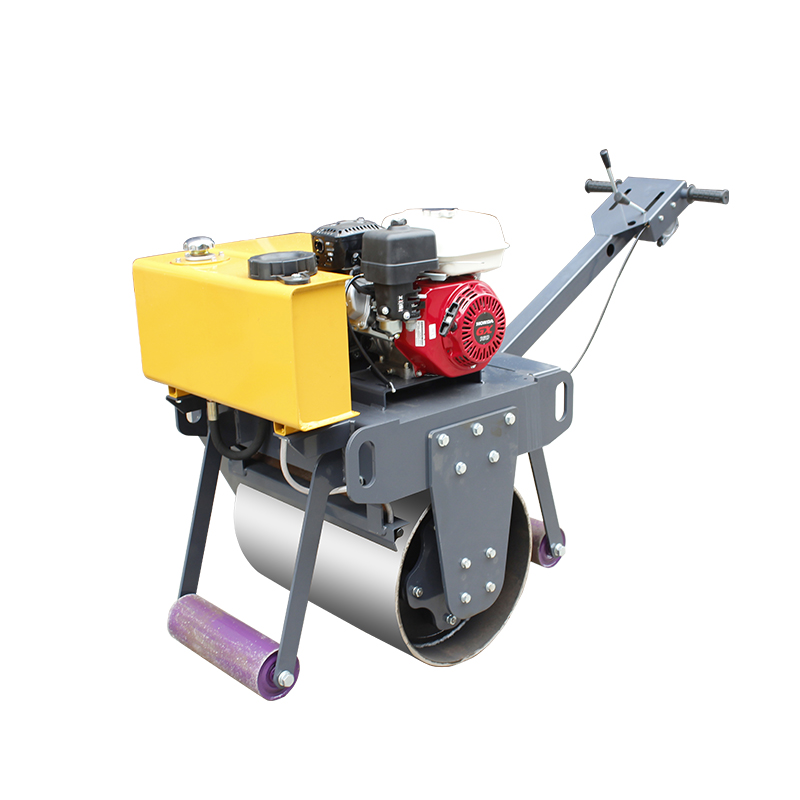
The compaction effect of a vibratory roller essentially depends on the "matching degree between vibration energy and material particle response". Amplitude determines the intensity and penetration depth of vibration energy, while frequency determines the response speed and reorganization efficiency of particle vibration. The two parameters must form a precisely matched combination based on material characteristics (particle gradation, cohesion, porosity) to avoid energy waste or material structure damage. The following analysis expands on the definition of core parameters, the adaptation logic for different materials, the quantitative impact laws, and practical operation principles, with no tables used throughout:
Amplitude refers to the maximum displacement of the steel drum during vibration (unit: mm), which directly determines the impact force on particles. The adjustment range of mainstream models is 0.3–2.5mm, divided into three levels based on applicable scenarios:
Small amplitude (0.3–0.8mm): Focuses on uniform surface compaction and structural protection.
Medium amplitude (0.8–1.5mm): Balances compaction degree and compaction depth.
Large amplitude (1.5–2.5mm): Prioritizes deep-layer high-impact interlocking.
Frequency is the number of vibrations of the steel drum per unit time (unit: Hz), which determines the resonance response speed of particles. The mainstream adjustment range is 25–40Hz, corresponding to three levels:
High frequency (35–40Hz): Accelerates the reorganization of fine particles.
Medium frequency (30–35Hz): Balances the interlocking efficiency and stability of medium-sized particles.
Low frequency (25–30Hz): Extends the impact contact time for coarse particles.
Vibration acceleration (unit: m/s²) comprehensively reflects the magnitude of energy, calculated by the formula:a = (2πf)²A×10⁻³(where A = amplitude, f = frequency). A higher acceleration means a faster compaction speed, but also a higher risk of material structure damage. The upper limit of acceleration must be controlled according to the material type.
Fine-grained materials contain ≥30% particles with a size ≤0.075mm, featuring strong cohesion and high porosity. The core of compaction is to break the cohesion while avoiding "hardened surface with loose interior" or "spring soil" (a phenomenon where the soil rebounds like a spring due to excessive moisture).
Impact of amplitude: Small amplitude (0.3–0.8mm) ensures uniform pressure transmission to deep layers, preventing large amplitude (≥1.5mm) from causing surface particle splashing and cohesion structure damage—these issues can increase moisture content and reduce compaction effectiveness. If the amplitude is ≤0.5mm, additional 2–3 rolling passes are required to meet standards due to insufficient energy.
Impact of frequency: High frequency (35–40Hz) promotes particle resonance, quickly breaking cohesion and accelerating particle rearrangement. This improves compaction efficiency by 20%–30% compared to low frequency (≤30Hz). Low frequency slows particle response, making it significantly harder to achieve the required compaction degree due to unbroken cohesion.
Optimal combination and effect: Small amplitude (0.5–0.8mm) + high frequency (35–40Hz), with vibration acceleration controlled at 10–15m/s². This achieves a compaction degree ≥95% (subgrade standard), porosity ≤25%, and no surface looseness or springing.
Medium-grained materials contain ≥70% particles with a size of 0.075–20mm, featuring weak cohesion and strong particle fluidity. The core of compaction is to promote particle interlocking while avoiding "particle slippage and insufficient compaction".
Impact of amplitude: Medium amplitude (0.8–1.5mm) provides sufficient impact force to drive particle collision and interlocking, achieving a compaction depth of 20–30cm (layered compaction). Small amplitude (≤0.6mm) leads to insufficient particle interlocking, requiring 2 additional rolling passes. Large amplitude (≥1.8mm) causes excessive particle displacement, reducing compaction uniformity.
Impact of frequency: Medium frequency (30–35Hz) balances particle response speed and interlocking time. It prevents high frequency (≥38Hz) from causing particles to "float" (unable to interlock effectively) and low frequency (≤28Hz) from reducing efficiency. For asphalt-stabilized macadam (containing binders), the frequency should be increased to 35–38Hz to minimize binder damage.
Optimal combination and effect: Medium amplitude (1.0–1.2mm) + medium frequency (30–35Hz), with vibration acceleration controlled at 15–20m/s². This achieves a compaction degree ≥96% (base course standard), increases the CBR (California Bearing Ratio) value by 50%–80%, and ensures tight particle interlocking without looseness.
Coarse-grained materials contain ≥70% particles with a size ≥20mm, featuring extremely high porosity and strong inter-particle friction. The core of compaction is to overcome friction and achieve deep-layer skeleton interlocking.
Impact of amplitude: Large amplitude (1.5–2.5mm) provides strong impact force, causing plastic deformation of coarse particles and forming a stable interlocked skeleton, with a compaction depth of 30–50cm. Medium amplitude (≤1.2mm) fails to penetrate deep layers, resulting in "dense surface and loose interior" and a compaction degree deficit of 5%–8%. For block stone soil (particle size ≥50cm), the amplitude should be further increased to 2.0–2.5mm to ensure effective transmission of impact energy.
Impact of frequency: Low frequency (25–30Hz) extends the impact contact time for coarse particles, ensuring sufficient displacement and interlocking. It prevents high frequency (≥32Hz) from causing "vibration rebound" (energy cannot transmit to deep layers), which leads to ineffective compaction (severe surface vibration with no deep-layer response).
Optimal combination and effect: Large amplitude (1.8–2.2mm) + low frequency (25–30Hz), with vibration acceleration controlled at 20–25m/s². This achieves a compaction degree ≥98% (rock-filled embankment standard), increases foundation bearing capacity by 30%–50%, and limits post-construction settlement to ≤5cm.
Binder-containing materials include asphalt or cement as bonding components. The core of compaction is to balance "compaction degree" and "binder structure protection" while avoiding binder detachment and aggregate crushing.
Impact of amplitude: Small amplitude (0.3–0.8mm) is critical. For asphalt mixtures, the amplitude must be ≤0.6mm; for cement-stabilized materials, it must be ≤1.0mm—this prevents large amplitude from damaging binder cohesion or aggregate skeletons. For asphalt surface layers (fine aggregates), the amplitude should be further controlled at 0.3–0.5mm to protect surface flatness and anti-skid performance.
Impact of frequency: High frequency (35–40Hz) improves the fluidity of asphalt mixtures, reducing rolling passes by 1–2 compared to medium frequency. For cement-stabilized materials, high frequency (32–35Hz) minimizes damage to hydration products. For SBS-modified asphalt mixtures (high viscosity), the frequency should be increased to 38–40Hz to match material properties.
Optimal combination and effect: For asphalt mixtures—small amplitude (0.3–0.6mm) + high frequency (35–40Hz), with a void ratio controlled at 3%–6%. For cement-stabilized materials—medium amplitude (0.8–1.0mm) + high frequency (32–35Hz), with strength loss ≤5%. Neither scenario causes aggregate crushing or binder detachment.
Small amplitude (0.3–0.8mm): Basic compaction depth is approximately 10cm. Each 0.1mm increase in amplitude raises the compaction degree by 0.5%–0.8%. Only suitable for fine-grained and binder-containing materials.
Medium amplitude (0.8–1.5mm): Compaction depth is 1.5–2.0 times the basic depth. Each 0.1mm increase in amplitude raises the compaction degree by 0.8%–1.2%. Suitable for medium-grained and conventional fill materials.
Large amplitude (1.5–2.5mm): Compaction depth is 2.0–3.0 times the basic depth. Each 0.1mm increase in amplitude raises the compaction degree by 1.2%–1.5%. Only used for coarse-grained and deep-layer compaction scenarios.
High frequency (35–40Hz): Compaction efficiency is 1.3–1.5 times the basic value (medium frequency), with a compaction uniformity coefficient ≤3%. Suitable for fine-grained and binder-containing materials.
Medium frequency (30–35Hz): Compaction efficiency is 1.0–1.3 times the basic value, with a uniformity coefficient ≤2%. A universal choice for medium-grained and conventional fill materials.
Low frequency (25–30Hz): Compaction efficiency is 0.7–1.0 times the basic value, with a uniformity coefficient ≤4%. Only suitable for coarse-grained and deep-layer compaction.
Same-direction adjustment (amplitude ↑ + frequency ↑): Only applicable to fine-grained materials. Energy superposition accelerates compaction, but acceleration must be controlled ≤15m/s² to avoid material structure damage.
Reverse adjustment (amplitude ↑ + frequency ↓): The optimal combination for coarse-grained materials. Large amplitude provides strong energy, while low frequency ensures sufficient particle interlocking time and prevents energy rebound.
Taboo combinations:
Large amplitude (≥1.5mm) + high frequency (≥35Hz): Excessive energy concentration causes particle splashing and structure damage, reducing compaction effect.
Small amplitude (≤0.6mm) + low frequency (≤30Hz): Insufficient energy fails to meet the required compaction degree.
Follow the logic of "first match the material, then adapt to the depth, and finally optimize efficiency":
Lock the amplitude level based on material type (fine-grained → small amplitude, medium-grained → medium amplitude, coarse-grained → large amplitude).
Adjust the frequency according to compaction depth (shallow layer ≤10cm → high frequency, medium-deep layer 10–30cm → medium frequency, deep layer ≥30cm → low frequency).
Verify through 100–200m test rolling, test compaction degree and flatness, and fine-tune parameters (amplitude ±0.1mm, frequency ±2Hz).
Expressway subgrade bottom layer (crushed stone soil, 30cm layered thickness): Amplitude 1.8–2.0mm + frequency 28–30Hz, 4–5 rolling passes, target compaction degree ≥95%.
Subgrade top layer (silty soil, 25cm layered thickness): Amplitude 0.6–0.8mm + frequency 35–38Hz, 3–4 rolling passes, target compaction degree ≥96%.
Cement-stabilized base course (12cm thickness): Amplitude 1.0–1.2mm + frequency 32–35Hz, 3–4 rolling passes, target compaction degree ≥97%.
Asphalt lower layer (AC-25, 8cm thickness): Amplitude 0.5–0.7mm + frequency 35–38Hz, 2–3 rolling passes, target compaction degree ≥98%.
Asphalt surface layer (SMA-13, 4cm thickness): Amplitude 0.3–0.5mm + frequency 38–40Hz, 2 rolling passes, target compaction degree ≥98%.
Narrow spaces (tunnels, foundation pits): Reduce amplitude by 0.2–0.3mm and increase frequency by 2–3Hz to minimize vibration impact on surrounding structures.
Low-temperature environments (≤10℃): For asphalt mixtures, increase amplitude by 0.1–0.2mm and frequency by 3–5Hz to compensate for insufficient material fluidity at low temperatures.
High-moisture materials (3% above optimal moisture content): Reduce amplitude by 0.2mm and increase frequency by 5Hz to avoid "spring soil".
Hazards: Using large amplitude for fine-grained or binder-containing materials causes surface looseness, aggregate crushing, and binder damage, which reduces compaction quality.
Avoidance: Strictly lock the amplitude level based on particle size. For fine-grained and binder-containing materials, control amplitude ≤1.0mm.
Hazards: Using high frequency for coarse-grained materials causes vibration energy rebound, preventing deep-layer penetration and resulting in "dense surface with loose interior".
Avoidance: Control the frequency at 25–30Hz for coarse-grained materials. Compensate for energy needs with large amplitude instead of relying on high frequency.
Hazards: Large amplitude + high frequency leads to excessive energy concentration; small amplitude + low frequency leads to insufficient energy. Both fail to meet the required compaction degree.
Avoidance: Follow the reverse combination principle—"fine-grained materials → small amplitude + high frequency, coarse-grained materials → large amplitude + low frequency"—to avoid energy mismatch.
Hazards: When acceleration ≥25m/s², structural damage is likely for any material, reducing compaction stability.
Avoidance: Control the upper limit of acceleration by material type—fine-grained ≤15m/s², medium-grained ≤20m/s², coarse-grained ≤25m/s².
The impact of vibratory roller amplitude and frequency on compaction effect lies in the "precise matching between vibration energy and material particle response". Amplitude determines energy intensity and penetration depth, while frequency determines energy transmission efficiency and particle reorganization speed. In practice, the amplitude level should first be locked based on material particle gradation, then the frequency matched to the compaction depth, and finally parameters fine-tuned through test rolling. The core adaptation logic is:
Fine-grained materials: High frequency + small amplitude for uniform compaction;
Coarse-grained materials: Low frequency + large amplitude for deep-layer interlocking;
Binder-containing materials: High frequency + small amplitude to balance compaction and protection.
This ultimately achieves the optimal balance of compaction quality, efficiency, and cost.



 Chinese