
 Chinese
- HOME >> NEWS >> Company news
NEWS
Latest Product
Contact Us
Track Material and Selection Recommendations for Tracked Carriers
2026-02-05I. Mainstream Track Materials and Characteristics
Rubber Tracks
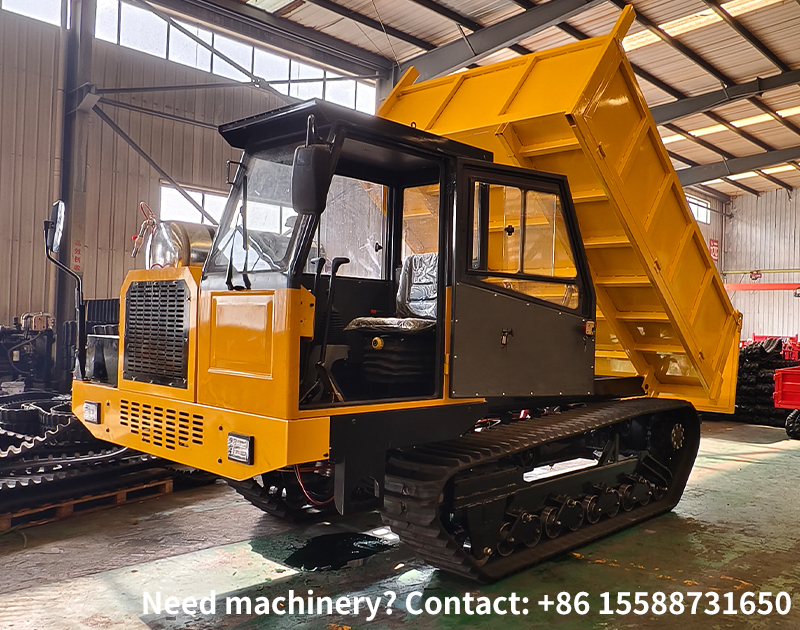
Made from natural rubber and synthetic rubber as the base material, embedded with high-strength steel cords for tensile resistance, and reinforced with nylon or aramid fabric to improve tear resistance.Advantages: Light weight, low vibration and noise, no damage to hardened pavements and farmland, lower fuel consumption, and easy disassembly/installation.Disadvantages: Weak wear and puncture resistance, vulnerable to cutting by sharp rocks and steel bars, and average high-temperature resistance.Application: Mostly used for models ranging from mini-sized to 8-tonne capacity.
Steel Tracks
Fabricated from high-manganese steel or wear-resistant alloy steel plates, with track shoes equipped with reinforcing ribs and anti-slip lugs.Advantages: Excellent wear resistance, puncture resistance, impact resistance, and strong heavy-duty load capacity, suitable for extreme road conditions such as rocky and mining areas.Disadvantages: High dead weight, high fuel consumption, large vibration and noise, damage to pavements and farmland, and greater steering resistance.Application: Mostly used for heavy-duty scenarios above 5 tonnes.
Reinforced / Rubber-Plastic Composite Tracks
Incorporate wear-resistant particles or metal inserts into the rubber matrix with a thickened rubber layer, balancing pavement friendliness and durability.Application: Suitable for compromise working conditions such as gravel earth roads, lightly rocky terrain, and mountainous fruit forests.
II. Track Shoe Pattern Selection
Flat or shallow-lug patterns: Suitable for hardened pavements and municipal/factory areas to reduce pavement wear.
Herringbone or chevron patterns: Universal type with balanced grip and drainage performance on farmland, earth roads, and sloped terrain.
Deep coarse lugs or rock drilling lugs: Designed for mines, rocky road sections, and steep-slope forestry, providing strong anti-slip and derailment resistance.Wide-face low-lug patterns: Exclusively for paddy fields, wetlands, and swamps to reduce ground contact pressure and prevent sinking.
III. Scenario-Based Selection Recommendations
Agriculture (Paddy Fields, Orchards, Farmland): Prioritize rubber tracks with herringbone or wide-face low-lug patterns to protect the tillage layer and prevent sinking. For hilly and sloped areas, deepened herringbone lugs can be used to enhance climbing performance.
Construction (Light-duty On-Site Transshipment): Use standard rubber tracks with herringbone patterns. For heavy-duty gravel road sections, select reinforced rubber tracks or steel tracks. Steel tracks are prohibited for road transshipment; only rubber tracks are applicable.
Forestry and Mountainous Areas: Use reinforced deep-lug rubber tracks for lightly graveled forest roads. Directly select steel tracks for bare-rock and heavy-duty logging scenarios. For forest protection, prioritize thickened wear-resistant rubber tracks.
Emergency Rescue: Prioritize anti-slip deep-lug rubber tracks. For sharp ruins environments, use puncture-resistant reinforced models to balance passability and transshipment efficiency.
Mines and Heavy-Duty Earthwork: Steel tracks with coarse rock drilling lugs are mandatory to ensure puncture/wear resistance and heavy-duty stability.
IV. Core Verification Points for Selection
Prioritize wide tracks for soft foundations and paddy fields; control ground contact pressure ≤ 0.15 MPa for better anti-sinking performance.
Track pitch must fully match the drive wheels and idlers to avoid tooth jumping and derailment.
Select cold-resistant rubber materials for low-temperature areas, and prioritize steel tracks for fireproof and high-temperature scenarios.
Rubber tracks feature quick replacement and low maintenance costs, while steel tracks have a longer service life but increase overall vehicle fuel consumption and wear on the running gear.