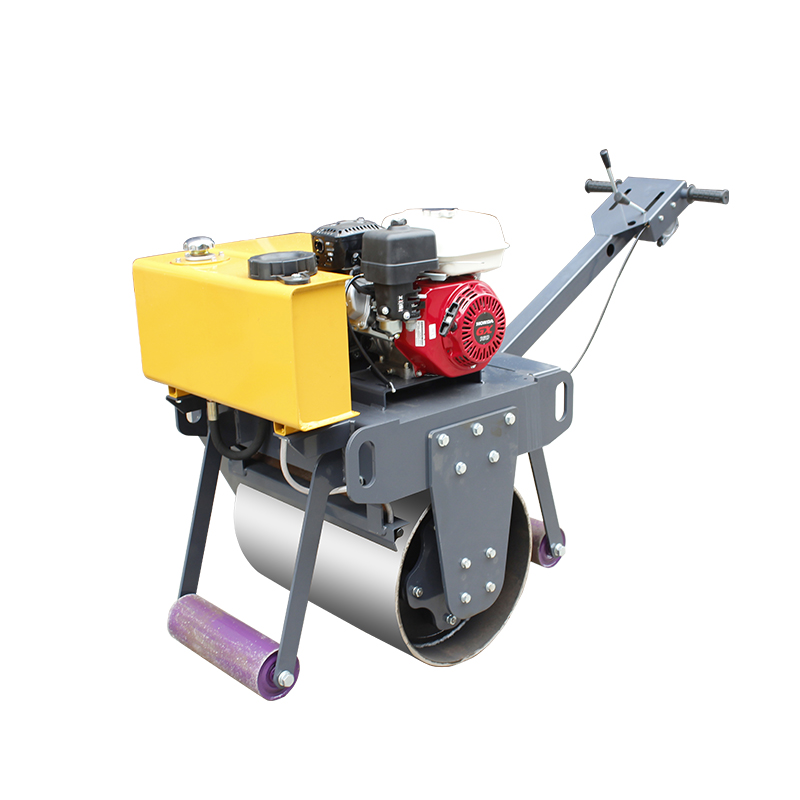
To determine whether the compaction effect of a road roller meets the standards, it is necessary to combine quantitative testing data (core basis) and qualitative visual observation (auxiliary judgment), focusing on the four core indicators of "compactness, flatness, strength, and impermeability". The judgment standards and methods vary across different engineering scenarios (subgrade, base course, surface course). The specific processes and methods are as follows:
Quantitative testing obtains specific values through professional instruments or experiments and compares them with design specifications (such as Technical Specifications for Highway Subgrade Construction and Specifications for Construction and Quality Acceptance of Urban Road Engineering). It is the "hard standard" for judging whether the compaction effect meets the requirements. The testing focus and methods differ for different engineering parts:
The subgrade and base course are the load-bearing foundations of the project. Insufficient compactness will lead to subsequent settlement and cracking. The core testing methods focus on "the degree of reduction in material porosity":
Sand Replacement Method (Most commonly used, applicable to soil and sand-gravel materials)Principle: Dig a test pit of a certain volume in the compacted layer, weigh the excavated material, then fill the test pit with standard sand (with known density) until it is full. Calculate the volume of the test pit based on the volume of the sand, and finally determine the "dry density" of the material (dry density = dry weight of material / volume of test pit). Compare it with the "maximum dry density" required by the design to obtain the compaction degree (compaction degree = measured dry density / maximum dry density × 100%).Compliance Standard: The compaction degree of the subgrade generally requires ≥ 90% (≥ 96% for the top layer of the roadbed), and the base course (cement-stabilized macadam) requires ≥ 97%-98%. If the compaction degree meets or exceeds the design value, the compactness is deemed up to standard.Note: The depth of the test pit must be consistent with the compacted layer thickness (e.g., if the subgrade is compacted in layers of 50cm, the test pit depth should be 50cm) to avoid "only testing the surface layer without testing the deep layer".
Ring Knife Method (Applicable to cohesive soil and silt)Principle: Use a metal ring (ring knife) of known volume to press vertically into the compacted soil, take out the ring knife with soil, dry and weigh it, then calculate the dry density and compaction degree of the soil. It is easier to operate than the sand replacement method but is only applicable to fine-grained soil (particle size < 5mm), not to crushed stone or rock-filled subgrades.
Nuclear Density Gauge Method (Rapid testing, applicable to large-area random inspection)Principle: Use radiation emitted by radioactive elements (e.g., cesium-137) to penetrate the material. Calculate the material density based on the intensity of the received radiation (the degree of radiation attenuation is positively correlated with density). It can quickly obtain dry density and compaction degree without digging pits, making it suitable for "rapid on-site random inspection" (e.g., 1-2 points sampled per 500㎡).Note: It needs to be calibrated regularly using the sand replacement method (to avoid instrument errors) and is not applicable to areas with steel bars or pipelines (metal interferes with radiation).
Deflection Testing (Indirectly reflects strength and compactness, mandatory for subgrade/base course)Principle: Use a deflectometer to test the vertical deformation (deflection value) of the subgrade/base course surface under the action of vehicle load (e.g., standard axle load of 100kN). The higher the compactness and strength, the smaller the deflection value (stronger deformation resistance of the material).Compliance Standard: The measured deflection value must be ≤ the design allowable deflection value (e.g., the deflection value of the expressway subgrade is usually ≤ 200 (0.01mm)). If it exceeds the standard, it indicates insufficient compaction or insufficient material strength, requiring re-compaction.
The asphalt surface course directly bears vehicle loads and environmental erosion. Compactness determines impermeability and rutting resistance, while flatness affects driving experience. Both indicators must meet the standards simultaneously:
Compactness Testing (Volume Method/Coring Method)Principle: Use a core drill to extract a complete core sample (diameter 100mm or 150mm) from the asphalt surface course, measure the volume and weight of the core sample, calculate the "bulk volume density", and compare it with the "theoretical maximum relative density" of the asphalt mixture to obtain the compaction degree (compaction degree = bulk volume density of core sample / theoretical maximum density × 100%).Compliance Standard: The compaction degree of the upper layer of the expressway asphalt surface course requires ≥ 97%, and the middle and lower layers require ≥ 96%. Insufficient compactness will cause the surface course to be prone to water seepage (rainwater seeps into the base course leading to freeze-thaw damage) or rutting (material displacement at high temperatures).
Flatness Testing (Continuous Flatness Meter/Laser Flatness Meter)Principle: A continuous flatness meter records the undulations of the road surface during driving through a "measuring wheel + displacement sensor" to calculate the "International Roughness Index (IRI)". A laser flatness meter has higher accuracy, which obtains real-time road surface elevation data through laser scanning and outputs the IRI value or the maximum gap of a 3m straightedge.Compliance Standard: The IRI value of the expressway asphalt surface course must be ≤ 2.0m/km, and the maximum gap of the 3m straightedge must be ≤ 3mm. Excessive flatness will cause rough driving and easily lead to local stress concentration on the surface course, accelerating cracking.
Thickness Testing (Coring Method/Ground Penetrating Radar Testing)Principle: Directly measure the thickness of the core sample after coring, or use ground-penetrating radar (non-destructive testing) to determine the surface course thickness through electromagnetic wave reflection (the propagation speed of electromagnetic waves varies in different media, and thickness is positively correlated with reflection time).Compliance Standard: The deviation of the measured thickness must be within the range of -5% to +10% of the design thickness (e.g., if the design thickness is 4cm, the measured thickness must be ≥ 3.8cm). Insufficient thickness will result in insufficient load-bearing capacity of the surface course and rapid wear.
For embankments and fill sites (e.g., industrial parks), in addition to compactness, impermeability (preventing water leakage) and compaction uniformity (avoiding local leakage) are key indicators:
Permeability Coefficient Testing (Variable Head Permeameter/Constant Head Permeameter)Principle: Take a compacted soil sample (or conduct an on-site water seepage test), measure the speed at which water penetrates the material under pressure, and calculate the "permeability coefficient" (the smaller the permeability coefficient, the stronger the impermeability).Compliance Standard: The permeability coefficient of the embankment anti-seepage body generally requires ≤ 1×10⁻⁶ cm/s. If it exceeds the standard, the number of rolling passes needs to be increased or the filling material needs to be improved.
Compaction Uniformity Testing (Multi-Point Sampling Comparison)Principle: In the same compacted section, select 10-15 testing points evenly using the "grid method" (e.g., 5m×5m grid), test the dry density or compaction degree of each point respectively, and calculate the standard deviation. The smaller the standard deviation, the more uniform the compaction.Compliance Standard: The standard deviation of compaction degree in the same area must be ≤ 2%. If the compaction degree of a point is more than 5% lower than the average value, the area needs to be re-compacted.
Although visual observation cannot replace quantitative testing, it can quickly identify obvious compaction defects, avoiding "invalid testing" or "delayed rework". Focus on the following 4 aspects:
No Obvious Wheel Tracks or DisplacementAfter rolling, there should be no clear compaction wheel tracks on the surface (especially after the final compaction of the asphalt surface course), and no material displacement, wrinkling, or heaving (e.g., if displacement occurs during high-temperature rolling of the asphalt surface course, it indicates excessive speed or insufficient compaction force). The surface of the subgrade/base course should be free of "loose peeling" (no floating soil when stepped on, and material particles do not fall off easily when rubbed by hand).
No Cracks or SettlementWithin 24 hours after compaction (especially for semi-rigid base courses such as cement-stabilized macadam), there should be no transverse or longitudinal cracks on the surface (cracks with a width > 0.2mm require attention). The fill area should have no local depression (e.g., the occurrence of "spring soil" after rolling—obvious rebound when stepped on and soft surface indicates excessive moisture content or insufficient compaction, requiring airing or re-compaction).
Dense Edges and JointsThe edges (e.g., road shoulders, slopes) and rolling joints (overlapping areas of adjacent rolling strips) of the subgrade/base course should be free of looseness and corner defects. Tap the edges lightly with a small hammer—there should be no "hollow sound" (a hollow sound indicates internal looseness). At the transverse construction joints (daily paving joints) of the asphalt surface course, there should be no steps or cracks. Use a 3m straightedge to test the flatness at the joints, with the maximum gap ≤ 3mm.
Water Seepage Phenomenon (Asphalt Surface Course/Embankment)A simple water seepage test can be conducted on the asphalt surface course: pour a small amount of water on the surface and observe whether the water seeps in quickly (for a qualified surface course that meets the standards, water will form droplets on the surface with no obvious seepage within 1 minute). For embankments, observe the slope after rain—there should be no obvious water seepage traces (e.g., wet spots or small water flows on the slope indicate that the impermeability does not meet the standards).
Step 1: Visual observation (no looseness, spring soil, or cracks) → Step 2: Sampling according to specifications (3-5 points sampled per 1000㎡) → Step 3: Test compaction degree with the sand replacement method + test deflection with a deflectometer → Step 4: If the compaction degree ≥ design value and deflection ≤ allowable value, it is deemed up to standard; otherwise, re-compact and test again.
Step 1: Visual observation (no wheel tracks, displacement, cracks, and flat joints) → Step 2: Core sampling (1 core sample taken per 2000㎡) → Step 3: Test the compactness and thickness of the core sample → Step 4: Test the IRI value with a laser flatness meter → Step 5: If all three indicators meet the standards, it is deemed qualified; if the compactness is insufficient, re-compact with a pneumatic tire roller (during the final compaction stage).
Step 1: Visual observation (no slope collapse, no water seepage after rain) → Step 2: Sampling with the grid method (1 point tested per 500㎡) → Step 3: Test compaction degree with the sand replacement method + test permeability coefficient with a permeameter → Step 4: If both indicators meet the standards, it is deemed qualified; if the permeability coefficient exceeds the standard, increase the number of rolling passes or replace with anti-seepage filling material.
Sampling Must Be "Representative": Testing points should avoid special areas such as edges and joints (tested separately) and be selected in accordance with the "random sampling" principle (e.g., determining points using a random number table). Avoid only testing "visually dense" areas, which may lead to distorted data.
Instruments Must Be "Calibrated": The standard sand used in the sand replacement method should have its density calibrated regularly. Nuclear density gauges and deflectometers should be sent to metrology institutions for calibration annually to avoid misjudgment caused by instrument errors (e.g., inaccurate standard sand density directly affects the calculation of dry density).
Auxiliary Judgment with "Construction Parameters": If rolling parameters (e.g., vibration frequency 25-30Hz, number of rolling passes 6-8, travel speed 3-4km/h) meet the design requirements and there are no obvious defects in appearance, the probability of quantitative testing meeting the standards is higher. Conversely, if rolling parameters exceed the standard (e.g., excessive speed, insufficient passes), even if a single test meets the standards, the scope of random inspection needs to be expanded.
In summary, whether the compaction effect of a road roller meets the standards must be judged comprehensively based on "quantitative testing data" as the core, combined with "visual observation" and "construction parameters". This ensures that the test results are objective and comprehensive, avoiding potential engineering quality hazards (such as subgrade settlement and road surface rutting) caused by "superficial compliance".



 Chinese