
 Chinese
- HOME >> NEWS >> Industry news
NEWS
Latest Product
Contact Us
How Do Excavators Achieve Precise Excavation Operations?
2025-10-11An excavator’s ability to perform precise excavation operations is the result of the collaboration between three factors: equipment hardware (precision control components), operating techniques (motion coordination), and auxiliary systems (intelligent tools). The core lies in aligning excavation movements (such as depth, angle, and position) with preset requirements by "controlling motion accuracy, optimizing operation logic, and utilizing auxiliary tools." This is applicable to scenarios requiring high precision, such as foundation pit excavation, pipeline laying, and slope trimming. The specific implementation approaches can be divided into the following four aspects:
I. Relying on Equipment Hardware: Precision Control Components as the "Fundamental Guarantee"
The core movements of an excavator (boom lifting/lowering, arm extension/retraction, bucket rotation) are driven by the hydraulic system. The "precision control design" at the hardware level directly determines whether the movements can be stable and controllable:
1. High-Precision Hydraulic Control System
Modern excavators generally adopt "electro-hydraulic proportional control" technology — electronic signals are used to precisely adjust the opening of hydraulic valves, controlling the flow and pressure of hydraulic oil, and avoiding "motion overshoot" in traditional hydraulic systems (e.g., intending to excavate 1 meter deep but ending up digging 1.2 meters due to excessive hydraulic flow). For example, when the boom is lowered, the electro-hydraulic proportional valve can slowly reduce oil volume, allowing the boom to lower at a constant speed instead of dropping suddenly; when the bucket rotates, the rotation angle can be precisely controlled (e.g., rotating only 45° for slope trimming), preventing material spillage caused by over-rotation.
2. Stable Travel and Support Structure
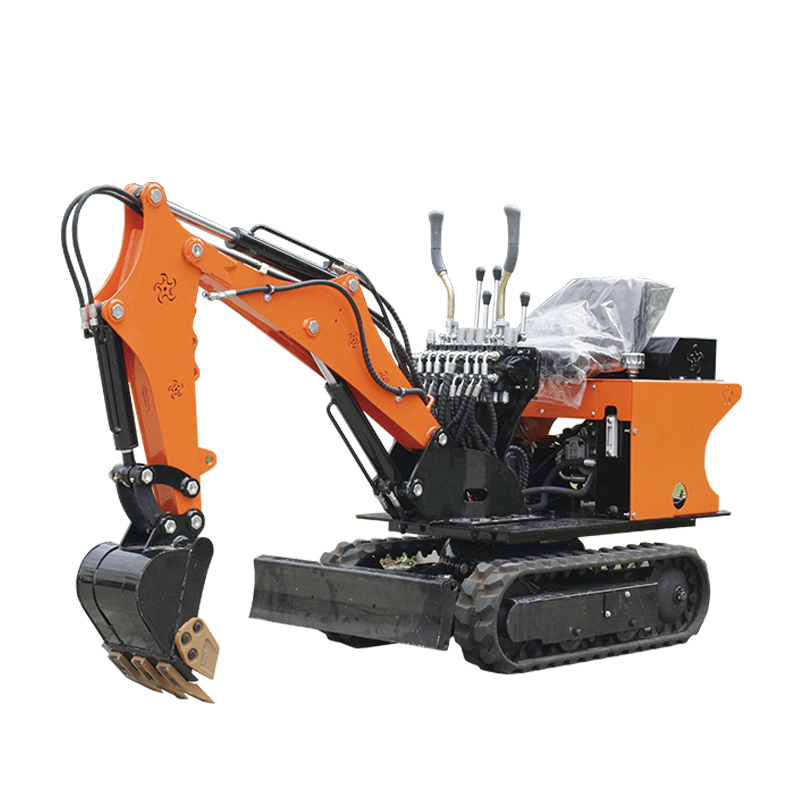
Precise excavation requires the excavator to have a "stable body": The track tension of crawler excavators can be adjusted (the tensioning device maintains track rigidity) to prevent body deviation caused by track shaking during operations; some small excavators are equipped with "adjustable outriggers" (e.g., micro-excavators). Before operation, the outriggers can be deployed and the body leveled to form a fixed support, further reducing the impact of excavation movements on the body posture (e.g., avoiding depth deviations caused by body tilting during excavation).
3. Accurate Motion Feedback Components
"Position sensors" on the equipment (such as angle sensors for the boom and arm) can real-time detect the position and angle of each component, and feed the data back to the operating lever (some models have vibration feedback) to help the operator perceive the movement range. For instance, when the bucket is approaching the preset depth, the sensor can issue a reminder via slight vibration of the lever to avoid over-excavation.

II. Optimizing Operating Techniques: Motion Coordination as the "Core Key"
Even if the equipment hardware meets standards, precise excavation still requires the operator to control movements through "slow motion, step-by-step operation, and careful observation" to avoid deviations caused by hasty operations:
1. Controlling Motion Rhythm: "Slowness" Is the Premise of Precision
During precise excavation, avoid quickly pushing or pulling the operating lever (e.g., suddenly lifting the boom or rotating the bucket). Instead, control movements at a "constant speed and with small amplitudes":
2. Step-by-Step Operation: Breaking Down Movements to Reduce Deviations
Decompose complex excavation tasks into individual movements of "positioning - cutting in - excavating - lifting - transferring," and control the precision of each step:
3. Enhancing Observation and Correction: Real-Time Adjustment to Compensate for Deviations
During operation, dual observation through "cab vision + auxiliary tools" is required to correct deviations in a timely manner:
III. Utilizing Intelligent Auxiliary Systems: Technical Tools as the "Efficiency Enhancer"
With technological development, more and more excavators are equipped with intelligent auxiliary systems, which reduce operational difficulty and improve precision through "automatic calculation and real-time guidance":
1. GPS/Beidou Positioning System: Enabling "Digital Precision"
Applicable to scenarios such as large foundation pit excavation and long-distance pipeline excavation: By installing a GPS antenna on the excavator and combining it with coordinate data in the construction drawings, the system can display "the deviation between the current excavation position, depth, gradient and the preset values" on the cab screen, and guide the operator to adjust movements in real time. For example, if the excavation depth needs to be controlled at 2 meters, the screen will display the current depth (e.g., 1.8 meters) and prompt "need to lower another 0.2 meters," avoiding errors from manual judgment.
2. Laser Leveling System: Solving the "Flatness Challenge"
Used in operations requiring high flatness, such as site leveling and roadbed excavation: A laser transmitter (emitting horizontal or inclined laser lines) is set up in the operation area. The laser receiver on the excavator can capture the laser signal. If the excavation surface is higher or lower than the laser line, the system will automatically issue a prompt (or slightly adjust the boom height via the hydraulic system) to ensure the excavation surface is flat. For example, when leveling a site, the laser system can control the flatness error within ±5 centimeters, far higher than the precision of manual operation.
3. Automatic Excavation Modes: Lowering the Operational Threshold
Some high-end models are equipped with "automatic excavation modes" (such as automatic depth control and automatic slope mode): The operator only needs to set the target depth or gradient, and the system will automatically control the movements of the boom, arm, and bucket, avoiding deviations from manual operation. For example, after activating the "automatic slope mode," the excavator can automatically maintain the angle between the bucket and the slope, and the operator only needs to control travel and platform rotation, greatly reducing operational difficulty.
IV. Pre-Operation Preparation: Planning and Calibration as the "Precision Premise"
Precise excavation does not rely solely on in-process operation control; "scene planning and equipment calibration" before operation are also crucial:
1. Clarifying Operation Requirements and Planning Excavation Schemes
Before operation, based on the construction drawings, clarify parameters such as "excavation depth, width, gradient, and flatness," and plan the excavation route:
2. Calibrating Equipment and Auxiliary Systems
If intelligent auxiliary systems (such as GPS or laser leveling) are used, the system precision must be calibrated before operation:
3. Cleaning the Operation Environment to Reduce Interference
Remove obstacles (such as rocks and trees) in the operation area to avoid movement deviations caused by obstacle blocking during excavation; if the ground in the operation area is uneven, first level the ground with the bucket to ensure the excavator is parked stably (the body tilt does not exceed 3°), preventing excavation depth deviations caused by body tilting.
Conclusion
An excavator’s achievement of precise excavation is the comprehensive result of "hardware (high-precision hydraulics, sensors) + technology (slow motion, step-by-step operation) + tools (intelligent auxiliary systems) + preparation (planning, calibration)." The core logic is: ensuring controllable movements through hardware, controlling motion precision through operating techniques, reducing errors through intelligent systems, and clarifying targets through pre-operation preparation. The combination of these four factors can control the excavation precision at the centimeter level, meeting the high-precision operation requirements of foundation pits, slopes, pipelines, and other scenarios.