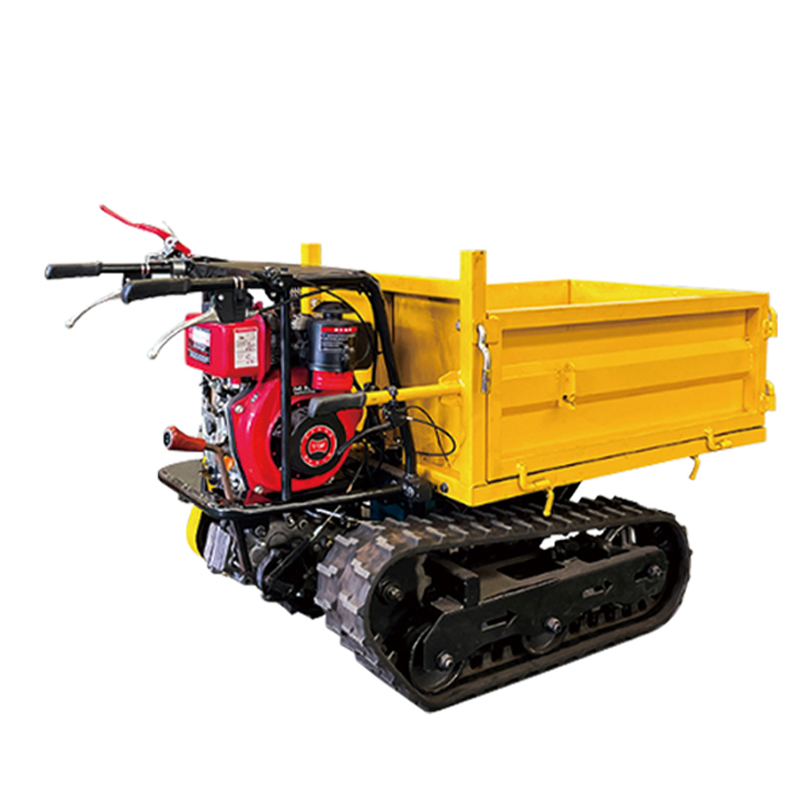
A remote-controlled lawn mower may slip or even lose control on steep slopes if it exceeds the model's climbing capacity, the ground is slippery/soft, or it is operated improperly. However, qualified tracked models are usually stable and controllable within their nominal safe slope range.
Exceeding slope limit: When the slope exceeds the designed climbing angle, insufficient driving force or unstable center of gravity will cause the mower to slide backward or tip over.
Poor ground conditions: Wet grass, mud, gravel, and thick layers of dead grass reduce the adhesion coefficient, significantly weakening traction and braking performance.
Improper operation: Sudden acceleration/braking, high-speed cornering, or failing to move along contour lines can easily trigger slipping or tilting.
Poor equipment condition: Abnormal air pressure, wear, or looseness of tracks/tires, or insufficient power from the battery/hydraulic system.
Abnormal signal and sensing: Strong obstacles/interference leading to remote control delays or packet loss, or failure of the slope sensor to trigger protection functions.
Clarify nominal capabilities: Check the "maximum climbing angle/stability angle" and "operable slope" of the mower, and do not operate it beyond the nominal values.
On-site assessment: Observe the flatness, coverage, and dry/wet condition of the slope. When the slope is wet after rain or has heavy dew in the early morning, reduce the slope gear or suspend operation temporarily.
Standardize operation:
Maintain low speed and small-angle steering; avoid sudden braking or sharp turns.
When operating horizontally, try to move along contour lines; when moving up and down the slope vertically, keep moving in a straight line.
Utilize slope sensing/automatic parking functions, and set up safety fences and electronic boundaries.
Equipment maintenance: Regularly inspect tracks/tires, tension, air pressure, and wear; keep the battery and hydraulic system in good condition.
Signal guarantee: Maintain line-of-sight with the mower and keep the remote control antenna horizontal; avoid strong interference sources. Conduct short-distance tests first in complex terrain.
Ensure "no slipping / no loss of control" is based on "matching model capabilities + correct operation + on-site assessment": A remote-controlled lawn mower can operate stably within its nominal safe slope range, with appropriate ground conditions and standardized operation; risks will increase significantly when exceeding limits or under harsh conditions.



 Chinese