Common classification methods of road rollers can be divided based on core characteristics, operation requirements, structural design, and other dimensions, as detailed below:
This is the most core classification method, directly determining a road roller’s compaction efficiency and applicable scenarios:
Static-Action Road Rollers: Compact materials solely by generating static pressure from the weight of their own rolling wheels, without additional power assistance. The compaction force is relatively moderate. They are suitable for the initial compaction of shallow soil and sand-gravel cushion layers, areas sensitive to vibration (e.g., subgrade construction near buildings), and can also be used for the final compaction and finishing of asphalt pavements.
Vibratory Road Rollers: On the basis of static pressure, a vibration device inside the rolling wheels generates high-frequency vibrations (usually 25-50Hz). The combined effect of "static pressure + vibratory impact force" acts on the materials, forcing particles to rearrange quickly, resulting in greater compaction depth and density. As the current mainstream type, they are widely used in deep subgrade compaction, compaction of asphalt mixture base and surface layers, and compaction of crushed stone layers.
Impact Road Rollers: Generate instantaneous impact force through the "free fall of the impact wheel" (similar to heavy hammer tamping). The compaction energy is concentrated and acts at a great depth (up to 1-5 meters), effectively handling difficult-to-compact materials such as collapsible loess and rock-filled subgrades. They are often used for foundation reinforcement in large-scale projects or pre-treatment before old pavement reconstruction.
Weight is directly related to the magnitude of compaction force and is adapted to different project scales:
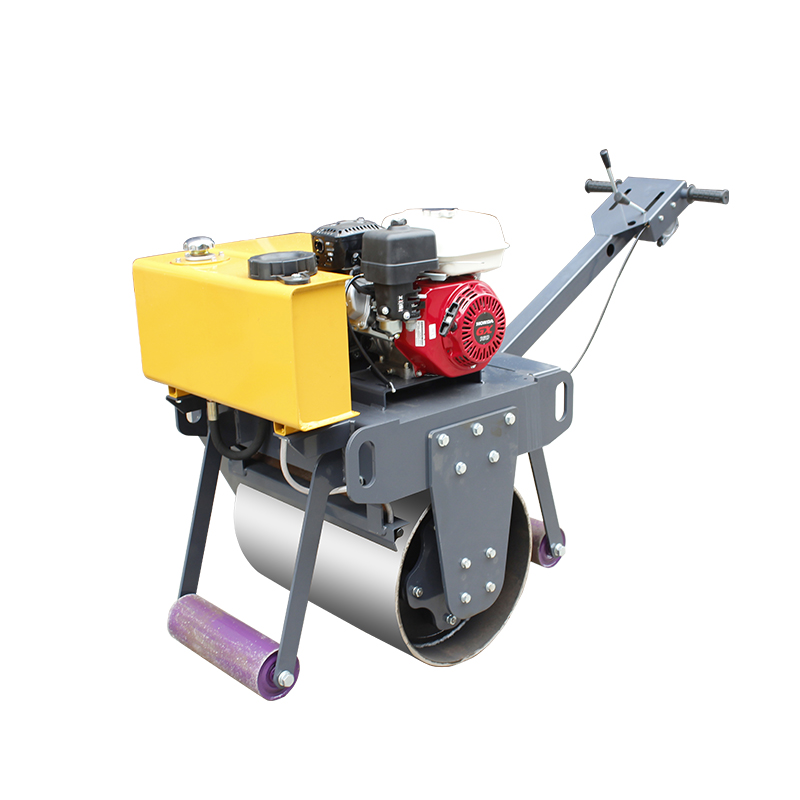
Micro Road Rollers: Usually weigh less than 1 ton, with a compact body (width mostly less than 1 meter) and flexible operation. They are suitable for working in narrow spaces, such as courtyard hardening, sidewalk paving, and compaction of backfill soil around pipelines.
Small Road Rollers: Weighing 1-6 tons, they balance flexibility and basic compaction force. They are mostly used in rural road and residential area road construction, or auxiliary compaction in large-scale projects (e.g., corner areas).
Medium Road Rollers: Weighing 6-10 tons, they have moderate compaction force and are suitable for medium-scale operations such as municipal road bases and subgrades of small and medium-sized highways. They are "general-purpose" equipment commonly used in municipal engineering.
Heavy Road Rollers: Weighing 10-16 tons, they have strong compaction force and good stability. They are mainly used in scenarios requiring high compactness, such as compaction of subgrades and base layers of expressways and first-class highways, and site leveling of large industrial parks.
Extra-Heavy Road Rollers: Weighing over 16 tons (some double-drum road rollers can reach more than 20 tons by adding counterweights), they are designed specifically for extremely high compactness requirements, such as the core compaction links of key projects like airport runways, high-speed railway track foundations, and large embankments.
The material, quantity, and shape of rollers determine the contact method with materials and compaction effect:
Steel Drum Road Rollers: Rollers are made of rigid steel structures, and can be further divided into "single steel drum" and "double steel drum" by the number of drums:
Single steel drum road rollers: Usually a combination of "front steel drum + rear rubber tires" (or all steel drums). The steel drum is responsible for main compaction, and the rubber tires assist in traveling and leveling. They are suitable for compaction of non-cohesive materials such as subgrades and base layers.
Double steel drum road rollers: Both front and rear are steel drums (mostly synchronous vibration), with uniform contact area with the pavement and high compaction flatness. They are "specialized equipment" for initial compaction, re-compaction, and final compaction of asphalt pavements.
Pneumatic Tire Road Rollers: Rollers are inflatable rubber tires (usually 3-5 front tires and 4-6 rear tires). They achieve flexible compaction through "elastic deformation of tires", which can transmit pressure evenly without damaging the material surface. They are suitable for final compaction of asphalt pavements (to improve flatness), compaction of cement-stabilized soil base layers (to avoid material cracking), or compaction of materials sensitive to steel drums (e.g., graded sand and gravel).
Sheepfoot Rollers: The roller surface is equipped with dense "sheepfoot-shaped protrusions". During compaction, the protrusions can insert into the soil, squeeze soil particles and expel air. They are especially suitable for subgrade compaction of cohesive soils (e.g., clay, silty clay), which can significantly improve soil compactness and shear strength.
Adapt to the space and operation requirements of different working environments:
Self-Propelled Road Rollers: Equipped with a power unit (mainly diesel engine) and an independent travel system, they can drive independently. By operation mode, they are divided into "ride-on type" (operators drive in a sitting position, suitable for large-area operations with high efficiency) and "walk-behind type" (operators control by hand, mostly small/micro models, suitable for narrow spaces).
Tow-Behind Road Rollers: Without an independent power unit, they need to be towed by equipment such as tractors and loaders. They have a simple structure and low cost but poor flexibility, and are only used in specific scenarios (e.g., compaction of large farm sites, construction of simple roads in remote areas).
Affect the smoothness of equipment operation and power transmission efficiency:
Mechanical Transmission Type: Transmit power through mechanical structures such as gears, clutches, and gearboxes. They have low cost and simple maintenance but poor transmission smoothness, and are mostly used in small and low-speed simple road rollers.
Hydro-Mechanical Transmission Type: Combine a hydraulic torque converter with a mechanical gearbox. Power transmission is smooth, and it can adapt to load changes (e.g., not easy to stall when rolling uneven roads). It was once widely used in medium-sized road rollers but is gradually being replaced by full hydraulic transmission.
Full Hydraulic Transmission Type: Control travel and vibration directly through hydraulic pumps and hydraulic motors. It has precise operation (can achieve stepless speed regulation and crab steering function), high transmission efficiency, and adapts to complex working conditions (e.g., steep slope operations). It is the mainstream transmission mode for medium and heavy road rollers currently.



 Chinese