

 Chinese
- HOME >> NEWS >> Industry news
NEWS
Latest Product
Contact Us
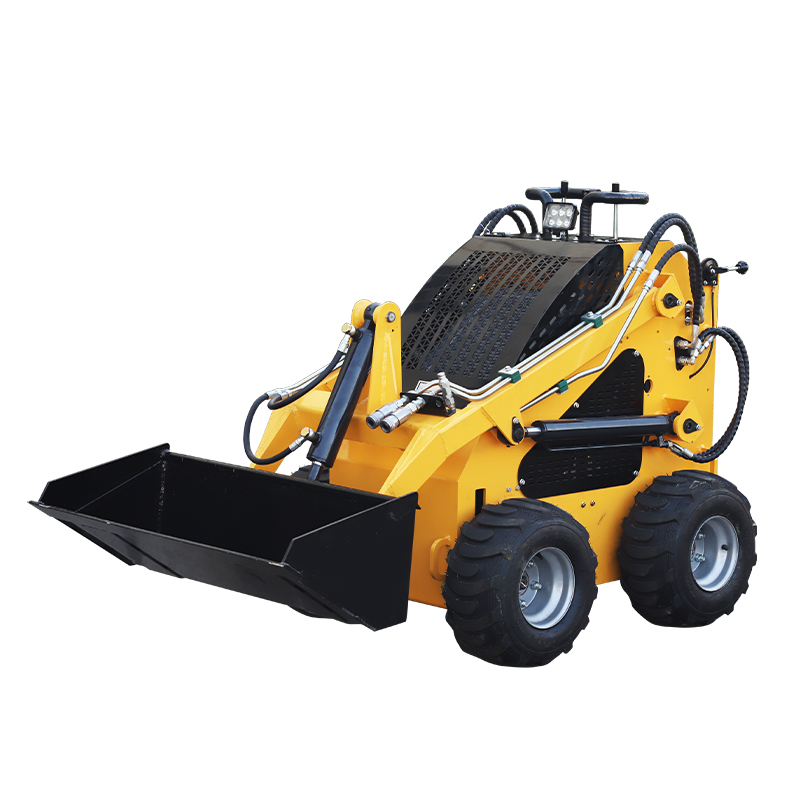
Why Is It Called a "Skid-Steer" Loader?
2025-04-30The term "skid-steer" originates from its unique steering mechanism and operating principle, which fundamentally differ from conventional wheeled equipment. This name vividly captures its distinct movement characteristics, as explained below:
1. Core Naming Origin: The Skid-Steer Mechanism
Non-Differential Steering Principle
Left wheel forward + Right wheel reverse → Zero-radius spin (pivot turn).
Left wheel fast + Right wheel slow → Tight-radius turn.
Comparison with Traditional Vehicles:
Standard vehicles: Use a differential to adjust wheel speeds for turning.
Skid-steer loaders: Left and right wheels/tracks are independently driven, enabling steering by counter-rotation.
Physical Manifestation of "Skidding":
During turns, the inner wheels/tracks forcibly slide or skid against the ground (especially noticeable with rubber tires).
Tracked models exhibit lateral scraping marks due to the skidding motion.
2. Mechanical Comparison with Conventional Steering
| Steering Type | Control Method | Min. Turning Radius | Ground Damage Risk |
|---|---|---|---|
| Skid-Steer | Left/right speed differential | 0 (spin on the spot) | High |
| Articulated | Frame bending | 1.2 × machine length | Medium |
| Front-Wheel | Wheel angling | 2.5 × machine length | Low |
3. Naming Standardization in Technical Evolution
Historical Context:
1957: Keller built the first skid-steer loader, patenting its "skidding steering" mechanism.
1960s: "Skid-Steer" became the industry-standard term.
Accuracy of Chinese Translation:
The term "滑移" (huáyí, "skid") precisely reflects the sliding friction between tires/tracks and ground during turns.
Distinct from other steering types like "crab steering" or "all-wheel steering."
4. Advantages Enabled by This Design
Ultra-Compact Maneuverability:
Completes 180° turns within a space equal to its own length (traditional equipment needs 3× more space).
Precision Positioning:
Fine-tuning left/right motor speeds allows centimeter-level adjustments (e.g., wall-adjacent work).
The name "skid-steer" not only describes the machine’s movement but also embodies its core capability to overcome spatial limitations, making it one of the most technically accurate terms in heavy equipment.
Key Insight:
The "skid" in skid-steer refers to the controlled sliding of wheels/tracks during turns—a defining feature that enables unmatched agility in tight spaces.