

 Chinese
- HOME >> NEWS >> Industry news
NEWS
Latest Product
Contact Us
What Are the Core Differences Between the Travel Systems of Wheel Excavators and Track Excavators?
2025-11-13The core differences between the travel systems of wheel excavators and track excavators stem from the distinct mechanical force transmission logics of "wheel-ground point contact" and "track-ground surface contact". Ultimately, these differences lead to full-chain structural differentiation centered around "mobility" and "ground adaptability", which can be elaborated on from the following core dimensions:
1. Differences in Core Design Objectives and Underlying Logic
Wheel Excavator Travel System
Its core objectives are "high-speed mobility + road compliance + low ground damage", making it suitable for urban hardened roads and short-distance relocation scenarios (≤50km). The performance priority is "speed > mobility > fuel consumption > ground damage control". Essentially, it achieves efficient movement through "point contact + rigid wheel transmission" to avoid damage to paved roads.
Track Excavator Travel System
Its core objectives are "extreme ground passability + high load-bearing stability + complex terrain adaptation", making it suitable for muddy/soft ground, mining sites, and off-road scenarios without hardened roads. The performance priority is "passability > stability > load-bearing capacity > speed". Essentially, it distributes pressure through "surface contact + flexible tracks" to solve the problems of sinking and traction loss in complex terrains.
2. Differences in Core Structures of Travel Mechanisms (Modules in Direct Contact with the Ground)
(1) Wheel Excavators: Integrated Tire-Axle-Suspension Design
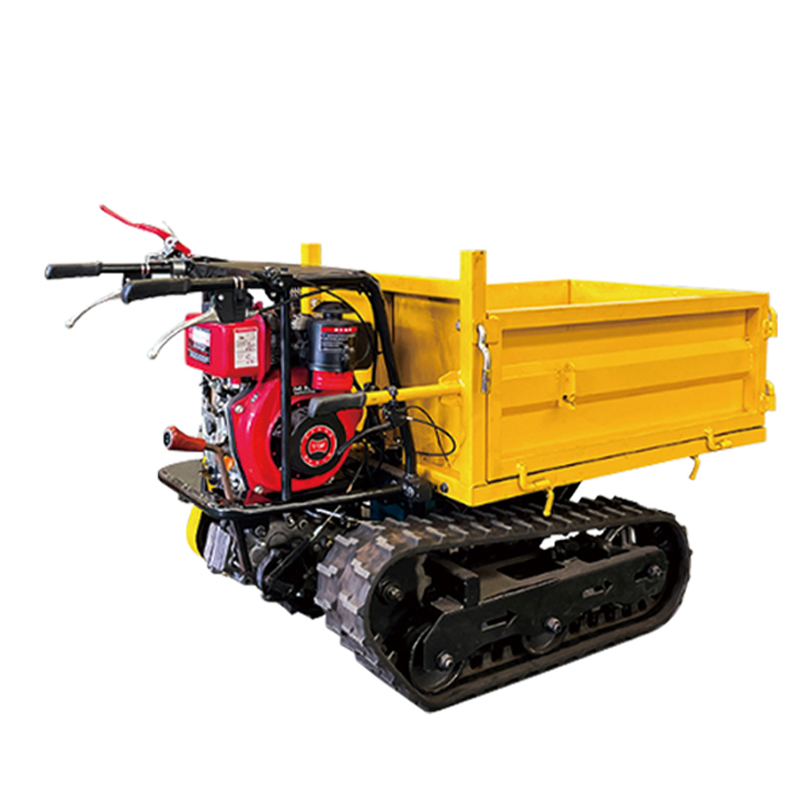
(2) Track Excavators: Track-Travel Frame-Roller Combination Design
3. Differences in Transmission System Structures
Wheel Excavators
Adopts a mechanical/hydraulic hybrid transmission path: "Engine - Gearbox - Drive Shaft - Axle - Tire". Equipped with a gearbox (manual or automatic) to realize multi-gear switching, meeting the different needs of high-speed highway travel and low-speed climbing during operations. The hydraulic system mainly assists in steering and differential lock control, featuring high power transmission efficiency and suitability for long-distance movement.
Track Excavators
Adopts a full-hydraulic transmission path: "Engine - Hydraulic Pump - Travel Motor - Gearbox - Drive Sprocket - Track". There is no gearbox; speed adjustment is achieved by regulating the displacement of the travel motor (only 1-2 travel gears). It has large power output torque and stable speed regulation. The gearbox is integrated into the drive sprocket to amplify torque, adapting to climbing in complex terrains and heavy-load operations. No drive shaft is required, resulting in a more compact structure but suitability for short-distance movement.
4. Differences in Steering System Structures
Wheel Excavators
Adopts an articulated frame + hydraulic power steering system. The body is divided into front and rear parts connected by an articulation point. During steering, hydraulic cylinders push the frame to rotate relative to each other, and steering is realized by coordinating with the deflection of the tires on the steering axle. It has a small turning radius (some models can achieve in-place turning), offering high mobility and suitability for operations in narrow urban sites.
Track Excavators
Adopts a "differential steering" design, with no articulated structure or steering axle. Steering is realized by adjusting the travel speed of the tracks on both sides (one side accelerates while the other decelerates or brakes); in-place turning is achieved by reversing the rotation direction of the tracks on both sides. During steering, the ground contact area remains unchanged, ensuring strong operational stability, but the turning radius is relatively large, and mobility is weaker than that of wheel excavators.
5. Differences in Support and Shock Absorption Structures
Wheel Excavators
Relies on "suspension system + tire elasticity" for shock absorption. The hydro-pneumatic suspension can automatically adjust damping according to road undulations, and the elastic deformation of the tires assists in cushioning impacts. During travel, the body vibration is small, providing high driver comfort while reducing the impact of vibration on the working device. The support structure is mainly based on the rigid connection between the axle and the suspension, balancing travel stability and operational load-bearing capacity.
Track Excavators
Has no independent suspension system and relies on "track flexibility + roller bushing buffering" for shock absorption. The elastic deformation of the track (rubber track) or the gap between track links (steel track) can absorb part of the ground impact, and the roller bushings are made of wear-resistant rubber to reduce rigid collisions. The support structure is mainly based on a rigid travel frame, ensuring a more stable connection between the body and the ground, strong anti-overturning capacity during operations, but weaker ride comfort than wheel excavators.
6. Differences in Structural Strength and Durability Design
Wheel Excavators
Focuses on strengthening the structural strength of axles, drive shafts, and suspension supports to cope with high-frequency vibrations and heavy-load pressure during highway travel. Tires and rims adopt thickened designs for puncture resistance and wear resistance. The transmission system emphasizes sealing performance to prevent dust and rainwater from entering during highway travel, meeting the durability requirements for long-distance movement.
Track Excavators
Focuses on strengthening the structural strength of travel frames, roller shafts, and drive sprocket rings to cope with impacts and wear in complex terrains. Track plates are made of high-strength steel (for steel tracks) or wear-resistant rubber (for rubber tracks), and track links and pins undergo quenching treatment to improve wear resistance. The sealing design of the wheel system focuses on preventing sand and mud from entering (e.g., rollers with double seals), meeting the durability requirements for harsh environments such as mines and muddy areas.
7. Summary of Core Differences
The core design logic of the wheel excavator travel system is "adapting to hardened roads + efficient movement". Through the combination of tires, axles, suspension, and gearbox, it achieves high-speed, mobile, and low-damage travel performance. The core design logic of the track excavator travel system is "adapting to complex terrains + stable load-bearing". Through the combination of tracks, travel frames, and full-hydraulic transmission, it achieves high passability, large torque, and strong stability in operational performance.
The structural differences between the two essentially result from design trade-offs guided by scenario requirements: wheel excavators sacrifice part of passability for mobility, while track excavators sacrifice part of mobility for ground adaptability—ultimately leading to the differentiation of core application scenarios for the two types of excavators.