

 Chinese
- HOME >> NEWS >> Industry news
NEWS
Latest Product
Contact Us
What are the benefits of using a skid steer loader compared to a conventional loader?
2025-04-15Skid-Steer Loaders vs. Conventional Loaders: Key Advantages in Specialized Applications
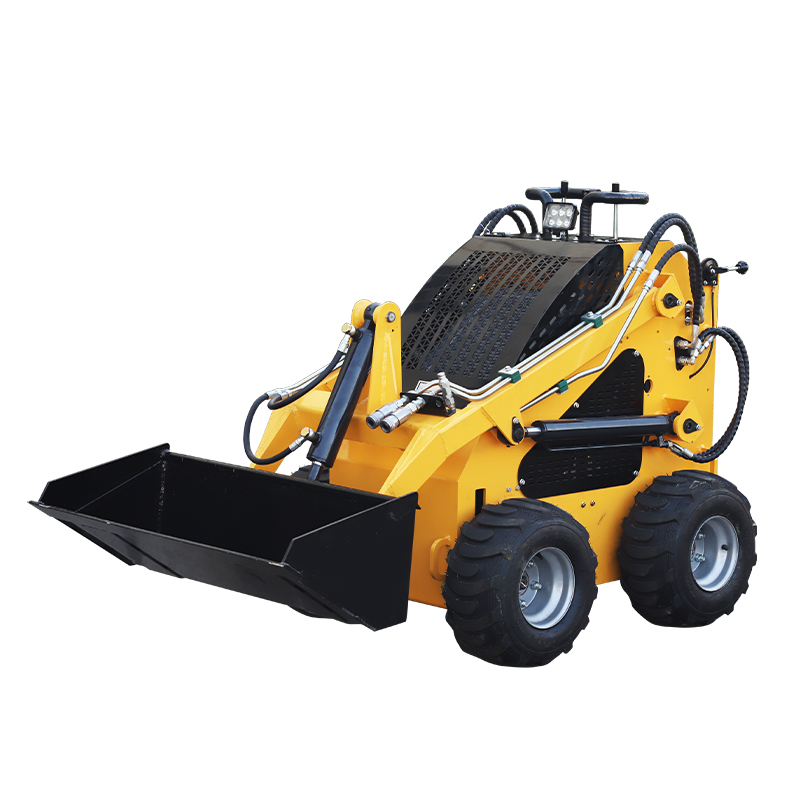
Skid-steer loaders outperform conventional loaders (e.g., 5-ton wheel loaders) in specific working conditions due to their unique structural and functional design, with notable advantages in the following aspects:
1. Unmatched Maneuverability for Confined Spaces
Compact Design: With a typical width under 2 meters, skid-steers access narrow construction sites, warehouses, and greenhouses, whereas conventional loaders require 3+ meters of operating space.
Zero-Turn Radius: Differential steering enables pivoting on the spot, ideal for tight areas; conventional loaders need larger turning circles.
Typical Applications: Indoor renovation, orchard greenhouses, municipal alleyways, and other space-constrained environments.
2. Superior Versatility
Quick-Attach System: Hydraulic interfaces allow tool changes in minutes (e.g., buckets, breakers, forks, sweepers, augers), enabling "one machine, multiple uses."
Expansive Attachment Ecosystem: Hundreds of specialized tools are available, while conventional loaders typically support only buckets or forks.
Example Use Cases:
Street sweeping (brush attachment)
Demolition (hydraulic hammer)
Logistics (pallet forks)
3. Higher Efficiency in Short-Distance Tasks
Rapid Response: Fully hydraulic drive ensures agile movements, perfect for high-frequency, small-volume jobs (e.g., loading mini dump trucks).
Operator Visibility: Compact size allows close monitoring of work surfaces (e.g., precise loading or corner cleaning).
Data Comparison:
In 50-meter material hauling, skid-steers can be 20% more efficient than 5-ton wheel loaders due to faster acceleration and steering.
4. Lower Operating Costs
Purchase Price: Mid-sized skid-steers cost 60K–90K for equivalent wheel loaders.
Fuel & Maintenance Savings:
Fuel consumption: 8–12L/h (skid-steer) vs. 15–25L/h (wheel loader).
Simpler mechanics reduce maintenance costs by 30%+.
5. Adaptability to Challenging Environments
Track Options: Rubber-track models exert ground pressure <30 kPa, excelling on soft terrain (mud, grass) where wheeled loaders may sink.
Electric Models: Zero-emission, low-noise electric skid-steers thrive indoors or in eco-sensitive zones.
Why Choose a Skid-Steer?
For tasks demanding space efficiency, multifunctionality, and cost savings, skid-steer loaders are the superior choice. However, conventional loaders remain better for heavy earthmoving or long-distance hauling.