

 Chinese
- HOME >> NEWS >> Industry news
NEWS
Latest Product
Contact Us
Application of Rollers in Subgrade, Base, and Surface Layer Construction
2025-06-26Rollers must adopt differentiated compaction strategies for different road structure layers (subgrade, base, and surface) to ensure bearing capacity, stability, and durability. Below are the specific application methods:
1. Subgrade Compaction (Earthwork/Rock Fill)
Core Objective: Provide uniform and stable support to prevent post-construction settlement.
Recommended Rollers:
Single-drum vibratory roller (10–26 tons)
Impact roller (for high-fill areas)
Key Construction Points:
Layered filling:
Loose thickness: Clay ≤20 cm, sandy soil ≤30 cm, rock fill ≤50 cm.
Each layer must achieve compaction density (≥93%).
Vibration parameters:
Low frequency, high amplitude (25–30 Hz, 1.8–2.0 mm) for deep compaction.
Compaction process:
1 static pass (stabilization) → 6–8 vibratory passes (3–5 km/h) → 1 final static pass (smoothing).
Special treatments:
Moisture control: Optimal water content ±2% (aerate if too wet, sprinkle if too dry).
Slope compaction: Roll from bottom to top at ≤2 km/h.
Quality Inspection:
Sand cone test for compaction density, deflection test for acceptance.
2. Base Layer Compaction (Cement-Stabilized Aggregate/Graded Gravel)
Core Objective: Form a high-stiffness transition layer to distribute loads to the subgrade.
Recommended Rollers:
Single-drum vibratory roller (12–18 tons)
Pneumatic roller (final kneading compaction)
Key Construction Points:
Material requirements:
Cement-stabilized aggregate: 4–6% cement content, compaction within 2 hours of laying.
Graded gravel: Maximum particle size ≤1/3 of layer thickness.
Compaction process:
Initial: 1 static pass (1.5–2 km/h).
Intermediate: 4–6 vibratory passes (30–35 Hz, 1.2–1.5 mm, 2–3 km/h).
Final: 2 pneumatic roller passes (eliminate micro-cracks).
Joint treatment:
Transverse joints: 20 cm overlap.
Longitudinal joints: Stagger by ≥1 m.
Quality Inspection:
Unconfined compressive strength (≥3–5 MPa for cement-stabilized layers), compaction density ≥98%.
3. Surface Layer Compaction (Asphalt Concrete)
Core Objective: Achieve high density, smoothness, and skid resistance.
Recommended Rollers:
Dual-drum vibratory roller (initial/intermediate compaction)
Pneumatic roller (final compaction)
Key Construction Points:
Temperature control:
Initial compaction: ≥140°C (standard asphalt) or ≥160°C (modified asphalt).
Final compaction: ≥90°C.
Three-stage compaction:
Initial: 1 static pass + 2 vibratory passes (45 Hz, 0.6 mm, 2–3 km/h).
Intermediate: 3–4 vibratory passes (40–45 Hz, 0.6 mm, 3–4 km/h).
Final: 2–3 pneumatic roller passes (4–5 km/h, eliminate marks).
Special requirements:
No sudden braking/turning to avoid aggregate displacement.
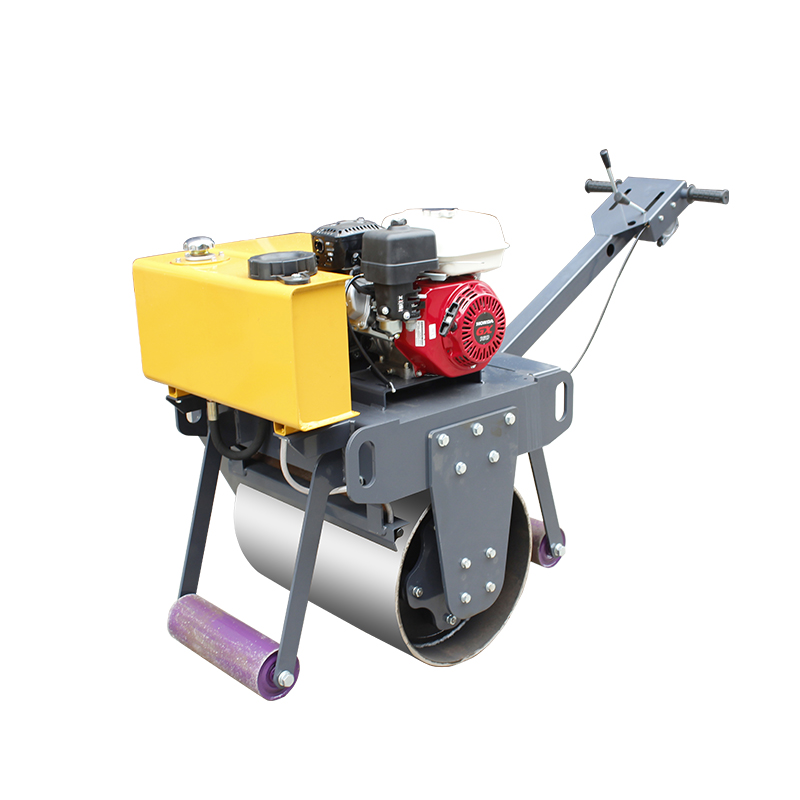
Hand-operated rollers for curbside compaction.
Quality Inspection:
Compaction density ≥96% (nuclear density gauge), air voids 3–7%, smoothness ≤3 mm/4 m.
4. Comparison of Roller Usage Across Layers
| Layer | Primary Equipment | Vibration Parameters | Passes | Speed | Quality Standard |
|---|---|---|---|---|---|
| Subgrade | Single-drum (20t) | 25 Hz / 1.8 mm | 6–8 | 3–5 km/h | Density ≥93% (sand cone test) |
| Base | Single-drum + pneumatic | 30 Hz / 1.2 mm | 4–6 | 2–3 km/h | UCS ≥3 MPa |
| Surface | Dual-drum + pneumatic | 45 Hz / 0.6 mm | 2+4+2 | 2–5 km/h | Density ≥96% (nuclear gauge) |
5. Troubleshooting Common Issues
Subgrade "springy soil": Aerate or mix with lime to reduce moisture, recompact.
Base cracking: Control cement content, cover and cure promptly.
Asphalt bleeding: Reduce water spray during pneumatic rolling.
6. Summary
Subgrade: Thick layers, low frequency, high amplitude, strict moisture control.
Base: Vibration + kneading, ensure material uniformity.
Surface: Precise temperature/speed control, three-stage compaction.
Follow the principles:
"Light to heavy, slow to fast, edges to center."
Verify parameters via test sections before full-scale construction!