In road construction, "joints" are critical weak points affecting the overall strength, flatness, and durability of pavements. Improper handling can easily lead to issues such as cracking, settlement, and water seepage. When handling joints, the core goals of roller operation are to ensure the material at the joint is fully compacted, tightly bonded to the existing structure, and has a smooth surface transition. Differentiated techniques are required for longitudinal joints (connections between front and rear sections of the same pavement width during construction) and transverse joints (vertical connections between new and existing pavements or different pavement widths), while operational details must be adjusted based on material properties (asphalt/stabilized soil/sand-gravel).
Regardless of the joint type, the following basic conditions must be met before roller operation to lay the foundation for subsequent compaction:
For connections between new and existing pavements (e.g., overlaying a new asphalt layer on an old pavement):
First, "roughen" the joint area of the existing pavement (mill a 3-5cm deep and 50-100cm wide area using a milling machine), remove floating dust and loose materials, and spray a bonding layer (asphalt for asphalt pavements or cement slurry for stabilized soil pavements) if necessary to enhance the bonding force between new and existing materials.
For longitudinal joints in the same pavement width (e.g., phased paving of asphalt pavements):
After constructing the first section, reserve a "stepped" edge (step height = paving thickness, width = 30-50cm) to avoid "edge chipping" at the joint.
For asphalt pavement joints: Strict temperature control is required:
Hot joints (short interval between front and rear paving sections, with the front section still uncooled): Ensure the temperature of the front section is not lower than 100℃, and the temperature difference between the rear and front sections does not exceed 10℃.
Cold joints (front section has cooled and hardened): Heat the edge of the front section to 120-150℃ (using an infrared heater) to avoid bonding failure caused by low-temperature compaction.
For stabilized soil/sand-gravel pavement joints: Ensure uniform moisture content (close to the optimal moisture content ±1%) to prevent uneven compaction due to moisture differences.
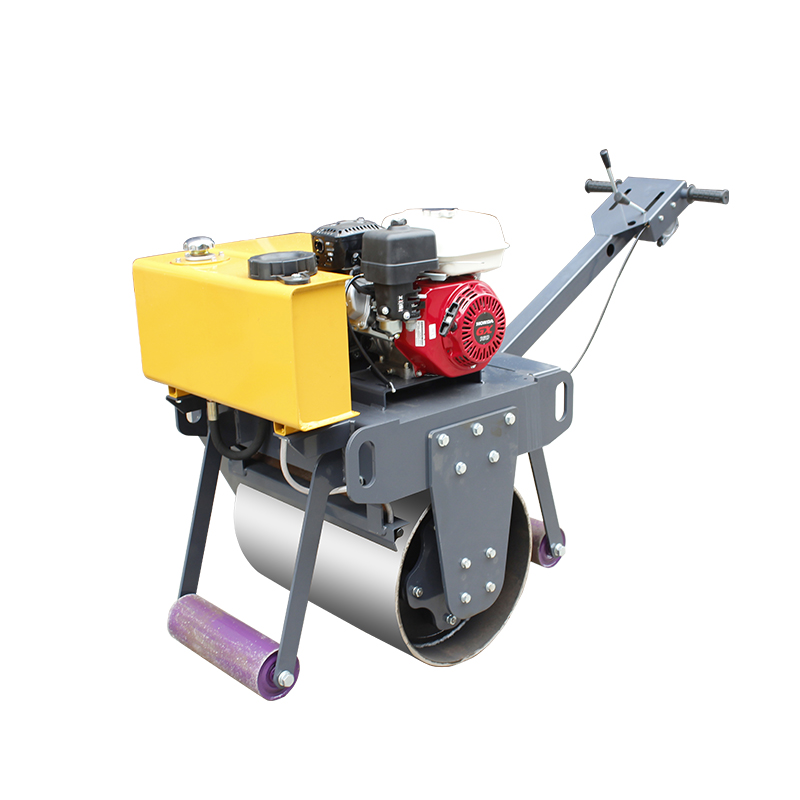
For joint compaction: Prioritize small vibratory rollers (e.g., 1-3t walk-behind rollers, 6-8t double-drum rollers) or pneumatic-tired rollers. Avoid large rollers (e.g., single-drum rollers over 20t), as their excessive weight may crush edges or cause structural deformation.
For narrow joints (e.g., near curbs or around manholes): Pre-treat with a rammer or small plate compactor, then supplement with roller compaction.
Longitudinal joints typically occur at the connection of two paving passes for wide pavements. The key is to "avoid compaction blind spots" and "ensure smoothness," with two scenarios: hot joints and cold joints.
Transverse joints are vertical connections between new and existing pavements (e.g., overlaying asphalt on old cement pavements, resurfacing old asphalt pavements) or different construction sections (e.g., section connections). The key is to "control settlement differences" and "prevent water seepage," with core techniques as follows:
If the existing pavement is an asphalt layer: First mill a "sloped surface" (10-15cm wide, slope 1:3, to avoid stress concentration from vertical cuts) and spray a bonding layer (emulsified asphalt, dosage: 0.3-0.5kg/㎡).
If the existing pavement is a cement layer: First mill a "rough surface" (20-30cm wide, exposing aggregates) and spray pure cement slurry (water-cement ratio: 0.4-0.5). Wait for the slurry to initially set before paving the new layer.
Static positioning: Use a double-drum roller (vibration turned off) to compact from the existing pavement to the new pavement. Overlap the drum with the new layer by 15-20cm and perform 1 static compaction pass. The goal is to initially bond the new layer material to the old layer and avoid material displacement caused by vibration.
Vibratory compaction: Turn on vibration (amplitude: 1.2-1.8mm, frequency: 26-30Hz) and gradually move the compaction position toward the new layer, shifting 10-15cm each time (i.e., "stepwise advancement"). Compact each step 2 passes, covering a 50cm range on both sides of the joint line to ensure uniform transition of compaction degree.
Edge supplementary compaction: If there is a road shoulder or curb at the edge of the new layer, use a small roller (e.g., 3t walk-behind roller) to compact along the edge to avoid "edge looseness" caused by the inability of large rollers to reach the area. For mid-pavement joints (e.g., section connections), set a 50cm wide "over-compaction zone" on both sides of the joint, then cut off the excess part after compaction.
Asphalt pavements: After compacting transverse joints, immediately check flatness with a 3m straightedge. If the error exceeds 3mm, locally mill the area with a milling machine and re-compact.
Stabilized soil/sand-gravel pavements: Avoid "dry material joints" at transverse joints. If the moisture content at the joint is too low, spray water to moisten before compaction to prevent formation of "loose interlayers."
Consequence: The new layer material is pushed, forming "bulges" or "material gaps."
Avoidance: During the first compaction pass, ensure at least 1/3 of the drum presses the old layer (for hot joints) or 1/2 presses the old layer (for cold joints), using the strength of the old layer to fix the new layer.
Consequence: Insufficient bonding force between new and old layers, leading to "delamination and cracking" in the later stage.
Avoidance: Cold joints of asphalt pavements must be milled and heated; for stabilized soil pavements, loose layers must be cleaned and water supplemented.
Consequence: Substandard compaction degree, leading to base settlement after rainwater infiltration.
Avoidance: The number of compaction passes at joints should be 1-2 more than in normal areas. On-site testing with a nuclear density gauge is required to ensure qualified compaction.
In summary, the core of roller joint handling lies in "proper pretreatment + adaptive compaction methods + material property matching." Flexible adjustments must be made based on differences between longitudinal/transverse joints and hot/cold joints to ultimately achieve joints with "qualified strength, smoothness without cracks, and water resistance."



 Chinese