

 Chinese
- HOME >> NEWS >> Industry news
NEWS
Latest Product
Contact Us
What are the advantages of tracked transport vehicles over wheeled transport vehicles on muddy roads?
2025-08-14On muddy roads, the advantages of tracked transport vehicles over wheeled ones stem from the fundamental differences in their ground contact methods and structural designs, which are specifically reflected in the following core aspects:
Practical effect: On soft roads such as mud and swamps, tracked vehicles can "float" on the surface, reducing the squeezing and sinking of the soil; while wheeled vehicles, due to high pressure, their tires are easy to get stuck in the mud, and even completely "sucked" and unable to move.
The contact between the track and the ground is "surface contact", and the entire track plate can transmit driving force with little power loss; while wheeled vehicles rely on "point contact" between tires and the ground, and the tire patterns in the mud are easily filled with mud, resulting in a sharp drop in friction, and most of the power is wasted in the form of slipping.
Practical effect: When a tracked vehicle starts, accelerates, and climbs slopes in mud, it can stably output power. Even if part of the track slips, the rest can still provide driving force; wheeled vehicles, on the other hand, are prone to tire idling, unable to effectively transmit power to the ground, and even slip in place, leading to getting stuck.
The continuous contact characteristic of the track makes it less likely to lose balance due to the fall of a single "support point" when crossing shallow pits and stones in the mud.
Limitations of wheeled vehicles: The tires of wheeled vehicles are discrete support points. If one tire gets stuck in a mud pit, it is easy to cause the vehicle body to tilt, and even other tires to leave the ground, losing driving force.
Limitations of wheeled vehicles: Tires (especially pneumatic tires) are easy to be punctured by sharp objects, blow out in the mud, or the bearings are damaged due to mud entering the wheel hub, so the failure rate is much higher than that of tracked vehicles.
Limitations of wheeled vehicles: Wheeled vehicles rely on the friction of the steering wheels for steering. In mud, the steering wheels are easy to slip, and the steering accuracy decreases; if the tires on one side get stuck in the mud, it may also cause difficulty in steering due to the excessive difference in resistance between the two sides.
Summary
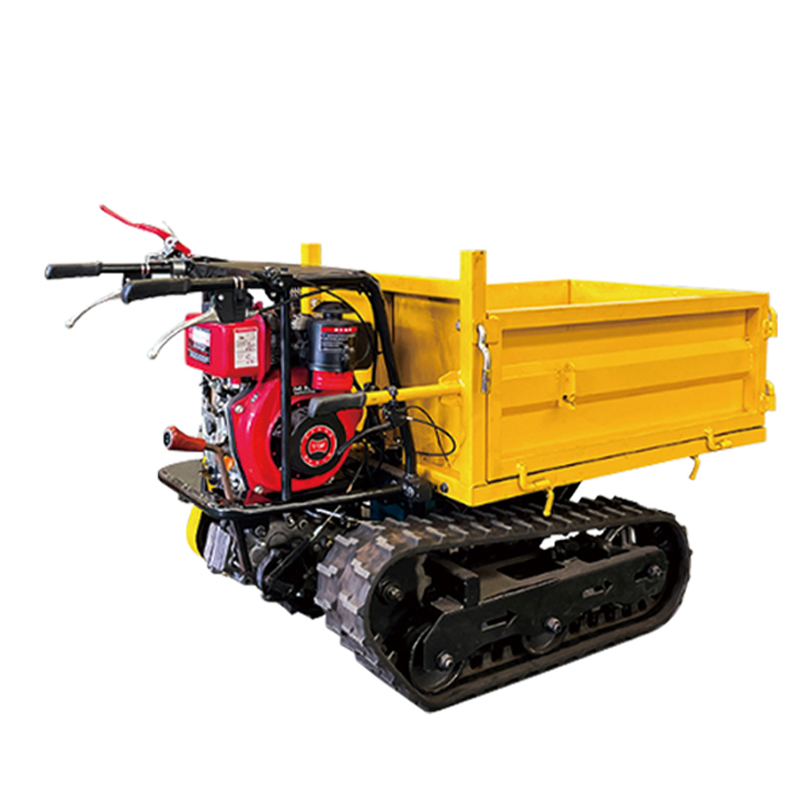
On muddy roads, tracked transport vehicles comprehensively surpass wheeled transport vehicles in passability and reliability through four core advantages: "large area and low pressure" to reduce sinking, "surface contact + deep patterns" to enhance grip, "long ground contact + flexible connection" to adapt to terrain, and "high-strength structure" to resist wear. This is why tracked transport vehicles have become the preferred tool in muddy scenarios such as agricultural fields, mining areas, and swamp rescue.