The core constraints of narrow spaces (tunnels, foundation pits) lie in limited spatial dimensions, complex operating environments, and strict quality requirements (e.g., foundation pits need to prevent collapse, tunnels need to ensure flatness). The selection of roller models must focus on four core dimensions—"spatial adaptability, operational flexibility, compaction effectiveness, and safety & environmental protection"—while meeting the requirements of "being able to enter the site, operate normally, and meet standards". The specific selection points are as follows:
Before selecting a model, it is necessary to accurately identify the key parameters of the site to avoid blind selection:
Spatial dimension constraints: For tunnels, this includes clear width (usually 3-5m), clear height (4-6m), and vault curvature; for foundation pits, it covers pit bottom width (2-4m), depth (3-10m), slope gradient (1:0.5-1:1.5), and operational turning space (≥1.5m).
Working surface characteristics: Compaction layer thickness (15-25cm for foundation pits, 8-12cm for tunnel base courses) and type of filling/material (for foundation pits: silty soil/gravel soil; for tunnels: cement-stabilized macadam/asphalt mixture).
Environmental and safety requirements: For tunnels, this involves ventilation conditions (whether forced ventilation is available), dust control (≤0.5mg/m³), and noise limits (≤85dB); for foundation pits, it includes anti-fall, anti-collapse requirements, and ground bearing capacity (≥150kPa).
This is the primary condition for model selection in narrow spaces, ensuring the roller "can enter, turn freely, and reach all compaction areas":
Body width: When the tunnel’s clear width is 3-5m, select small rollers (double steel drum/pneumatic tyred) with a body width of 1.8-2.5m; when the foundation pit’s bottom width is 2-3m, prioritize micro-rollers (single steel drum/double steel drum) with a width ≤1.8m to avoid insufficient lateral coverage or turning difficulties due to excessive width.
Body height: When the tunnel’s clear height is 4-5m, choose low-body models with a height ≤2.8m (to avoid touching the vault); for foundation pits with large depths, consider the height limit of transportation channels (e.g., ramps) and prioritize models with detachable or foldable handrails.
Turning radius: Narrow spaces lack sufficient turning room, so select articulated or small rigid models with a turning radius ≤3m (double steel drum rollers typically have a turning radius of 2-2.5m, micro-rollers ≤1.5m) to prevent incomplete compaction of corners due to excessive turning radius.
Operation coverage: For blind areas such as foundation pit corners and tunnel wall bases, prioritize models with "offset steel drums" (offset ≥15cm) or "narrow steel drums" (steel drum width 1.2-1.5m) to ensure no compaction dead zones (blind area width ≤10cm).
Narrow spaces have irregular working surfaces that require frequent direction adjustments, so the roller must feature "small-radius steering, precise control, and rapid adaptation to working conditions":
Drive mode: Prioritize full-hydraulic drive models (more flexible steering and smoother power transmission than mechanical drive), which can achieve in-place or small-angle steering to adapt to frequent direction adjustments.
Control system: Select models with pilot-operated control levers or electronic control systems for easy operation and quick response, reducing operator fatigue (high workload in narrow spaces); some high-end models are equipped with "tiltable consoles" for better visibility of blind working areas.
Travel speed: Support low-speed constant travel (0.8-3km/h) to avoid uneven compaction or collisions with slopes/tunnel walls caused by excessive speed; at the same time, have a fast transfer speed (≥8km/h) to improve operational efficiency.
Climbing capacity: Foundation pit ramps typically have a gradient of 15°-25°, and tunnel entrances/exits may also have slopes. Select models with a climbing capacity ≥25° (hydraulic drive models outperform mechanical drive in climbing) to ensure safe and stable travel on ramps.
Compaction quality in narrow spaces directly affects structural stability (e.g., insufficient compaction of foundation pits may cause subsequent settlement, while insufficient compaction of tunnel base courses affects pavement load-bearing). It is necessary to ensure compaction effectiveness while using "small models":
Tonnage matching: Select based on compaction layer thickness and material type:
Foundation pit filling (silty soil/sandy soil): Use 3-6t small single steel drum vibratory rollers (static linear load ≥200N/cm) or 4-8t double steel drum vibratory rollers to ensure sufficient static pressure to penetrate the compaction layer.
Coarse-grained filling in foundation pits (gravel soil): Use 6-8t small single steel drum vibratory rollers (amplitude 1.2-1.8mm) to promote particle interlocking through vibration energy.
Tunnel base course (cement-stabilized macadam): Use 6-10t double steel drum vibratory rollers (static linear load ≥250N/cm) to avoid base course damage or collisions with tunnel walls due to excessive tonnage.
Tunnel asphalt surface course: Use 4-6t light double steel drum vibratory rollers (amplitude 0.3-0.5mm) to balance compaction degree and flatness.
Vibration parameter adaptation: In narrow spaces, vibration energy must be controlled to prevent slope collapse or tunnel structure damage caused by excessive vibration:
Foundation pit compaction: Amplitude 1.0-1.8mm, frequency 25-30Hz (high frequency and medium amplitude to balance compaction degree and vibration impact).
Tunnel compaction: Amplitude 0.3-1.0mm, frequency 30-35Hz (high frequency and small amplitude to avoid vibration transmission to tunnel linings).
Impact rollers (excessive vibration impact) or large-amplitude models (amplitude ≥2.0mm) are prohibited.
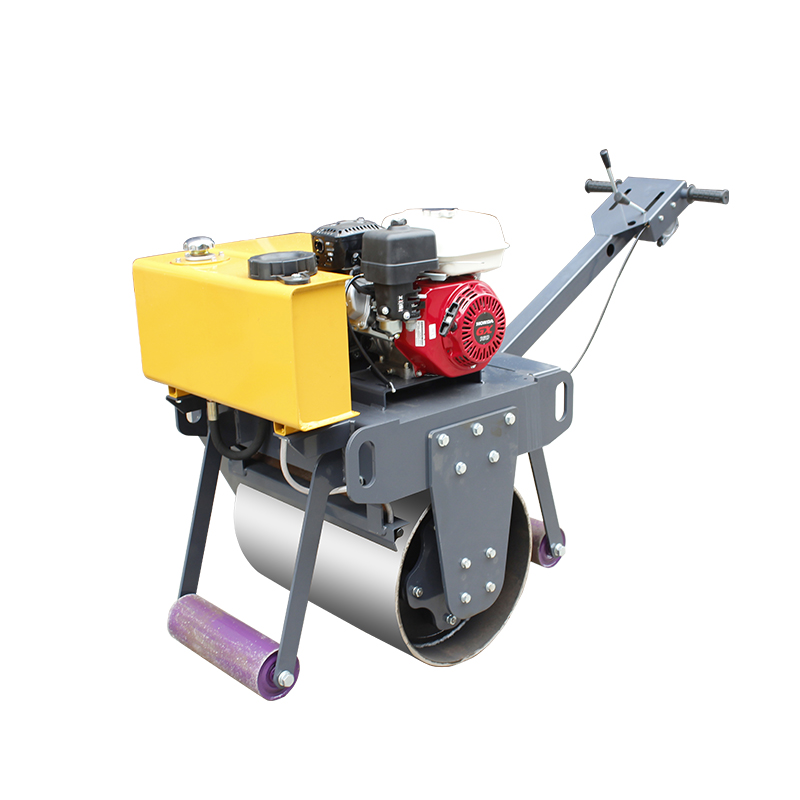
Compaction method selection: For corner blind areas, auxiliary compaction can be done with "walk-behind micro-rollers" (1-3t), or select models with "adjustable vibration eccentric blocks" to adjust vibration intensity according to the operation position (e.g., turn off vibration for static rolling near slopes).
Narrow spaces have poor ventilation, limited visibility, and high safety risks, so the roller must meet strict safety and environmental requirements:
Safety protection:
Equip with Roll-Over Protective Structure (ROPS) and Falling Object Protective Structure (FOPS) to prevent risks of slope falling rocks or machine rollover.
Steel drum edges must have anti-collision rubber strips to avoid collisions with tunnel walls or foundation pit slopes.
Equip with reverse cameras and sound-light alarm devices (poor visibility in narrow spaces requires warnings for surrounding personnel).
Environmental requirements:
For tunnel operations, prioritize electric or hybrid models (zero emissions, low noise) to avoid exhaust accumulation from fuel-powered models (poor ventilation may lead to excessive carbon monoxide). If fuel-powered models are used, they must be equipped with exhaust purification devices (e.g., three-way catalytic converters).
Noise control: Select models with noise ≤80dB (5-10dB lower than conventional rollers) to reduce impacts on operators and the surrounding environment.
Reliability and maintainability: Equipment failure maintenance in narrow spaces is difficult, so select models with simple structures and low failure rates (e.g., small-series models from well-known brands); key components (hydraulic systems, vibration motors) must have protective designs to avoid collision damage; the machine body must reserve sufficient maintenance space for on-site quick repairs.
Tunnel base course (cement-stabilized macadam, thickness 8-12cm): 6-10t double steel drum vibratory roller (body width 2.0-2.3m, turning radius ≤2.5m, amplitude 0.8-1.0mm) + 4-6t light double steel drum roller (for final compaction and leveling).
Tunnel asphalt surface course (thickness 4-6cm): 4-6t light double steel drum vibratory roller (body width 1.8-2.0m, amplitude 0.3-0.5mm); pneumatic tyred rollers are prohibited (limited space in tunnels reduces their steering flexibility, and they easily adhere to the mixture).
Tunnel corner blind areas: 1-3t walk-behind micro double steel drum roller (width ≤1.2m, operable by one person, flexible movement between wall bases and working surfaces).
Compaction of silty soil/sandy soil in foundation pits (layer thickness 15-20cm): 3-6t small single steel drum vibratory roller (body width 1.5-1.8m, amplitude 1.2-1.5mm) + 1-2t walk-behind roller (for corner compaction).
Compaction of gravel soil in foundation pits (layer thickness 20-25cm): 6-8t small single steel drum vibratory roller (body width 1.8-2.0m, amplitude 1.5-1.8mm) to ensure dense particle interlocking.
Narrow foundation pits (pit bottom width ≤2m): 1-3t walk-behind micro single steel drum roller (turning radius ≤1.5m, capable of in-place steering, full coverage of the working surface).
Using conventional heavy-tonnage rollers (≥12t): Excessive body width (≥2.5m) prevents entry into narrow spaces, or excessive turning radius causes compaction blind areas.
Using pneumatic tyred rollers in tunnels: Poor steering flexibility leads to easy collisions with tunnel walls, and tyre adhesion to the mixture affects pavement flatness.
Using large-amplitude models (amplitude ≥2.0mm) in foundation pits: Excessive vibration impact easily causes slope collapse, especially in soft soil foundation pits with higher risks.
Pursuing "small size" while ignoring compaction effect: Selecting models with excessively small tonnage (≤2t) and no vibration function fails to meet the design compaction degree (e.g., foundation pit compaction degree ≥95%).
Ignoring environmental adaptability: Using fuel-powered models without exhaust purification in tunnels may cause operator poisoning due to poor ventilation.
Neglecting transportation and site entry: Although the roller size meets site requirements, it cannot pass through transportation channels (e.g., foundation pit ramps, tunnel entrances); it is necessary to confirm transportation dimensions in advance (e.g., height after handrail disassembly).
Before selection, measure the site dimensions (clear width, clear height, turning space) on-site, draw a working surface diagram, and determine the maximum width/height of the roller based on "site size limit - 0.2m".
Prioritize models with flexible configurations (e.g., adjustable steel drum width, detachable handrails) to improve site adaptability.
Conduct trial operation verification: Test the roller’s passability and compaction effect (use a nuclear density gauge to detect compaction degree) on the site edge or test section (length 50-100m), and confirm no issues before large-scale operation.
The core logic for selecting roller models in narrow spaces is "space first, function adaptation, safety and environmental protection"—first lock the roller’s width, height, and turning radius based on site dimensions, then match tonnage and vibration parameters according to compaction materials and thickness, and finally select the drive mode and safety configuration based on environmental requirements. The key is to avoid "overpowered machines for small tasks" (large models cannot enter the site) or "underpowered machines for heavy tasks" (small models fail to meet compaction standards). Through a combination of "main models + auxiliary models" (e.g., small double steel drum rollers + walk-behind micro-rollers), full working surface coverage without blind areas and high-quality compaction can be achieved.



 Chinese