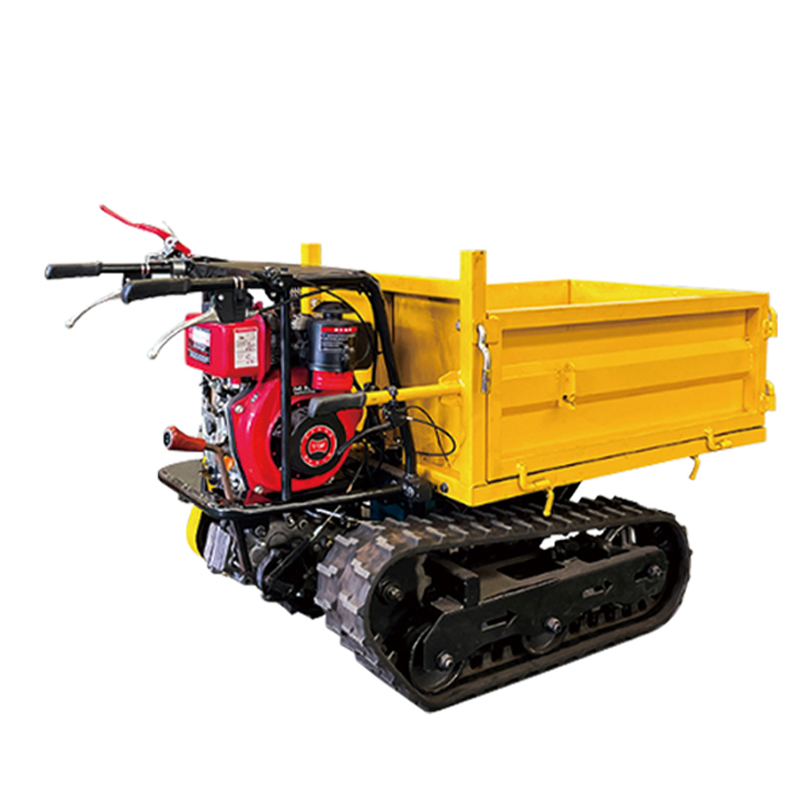
The blades of remote-controlled lawn mowers require regular sharpening or replacement. This is a core maintenance step to ensure cutting performance, extend the machine's service life, and prevent lawn damage. The wear rate of the blades is directly related to the frequency of use, lawn terrain (whether it contains gravel/thick stems), and blade material. The maintenance cycle should be determined based on actual operating conditions.
Blades do not need to be replaced "only when they break". You should sharpen or replace them promptly when the following situations occur:
If the lawn has an uneven stubble height, shows signs of "grass tearing" (the cross-section of grass stems is rough instead of smooth), has severe missed cuts, or the entire lawn turns yellow after cutting (due to excessive water loss from large wounds), it indicates that the blades have become dull. In this case, sharpening is the priority.
If the blade edge has obvious nicks, curling, deformation (such as bending), or the cutting edge is worn to the point of "losing sharpness" (when touched lightly by hand, there is no obvious cutting sensation and no burrs):
If the nicks/deformation are severe and cannot be repaired by sharpening, the blade must be replaced directly.
Minor nicks can be remedied by sharpening.
Reference for regular usage scenarios (taking household models as examples):
Cemented Carbide/PM-HSS Blades: Highly durable, requiring replacement every 1-2 years (or after 100-200 hours of cumulative operation). During this period, light sharpening can be done every 3-6 months.
Ordinary High-Speed Steel (HSS) Blades: Sharpen every 3-6 months, and replace after approximately 1 year of cumulative use.
Manganese Steel Blades/Grass-Cutting Strings: Sharpen manganese steel blades every 2-3 months; replace grass-cutting strings directly after wear (usually every 1-2 months, depending on the wear rate).
The core principles of blade replacement are "cut off power/fuel to prevent accidental startup + accurate alignment to prevent vibration". The specific steps and precautions are as follows:
This is the most critical safety prerequisite and must not be skipped:
Electric Remote-Controlled Lawn Mowers: Unplug the power cord (or disconnect the battery connection cable), turn off the machine's power switch, and wait for 1-2 minutes to ensure the capacitor is fully discharged to prevent accidental startup via the remote control.
Gas-Powered Remote-Controlled Lawn Mowers: Turn off the engine, pull out the spark plug wire (or turn off the fuel switch), and wait for the engine to cool down completely (for at least 10 minutes) to prevent burns from high-temperature components or fuel leakage.
Place the lawn mower stably on a flat surface. Use stones or wooden blocks to chock the front/rear wheels to prevent the machine from sliding. If the machine has a "parking lock" function, enable it to ensure the blades are completely fixed and will not rotate due to gravity.
Distinguish Between "Clockwise and Counterclockwise" for Screws: Most blade-fixing screws of lawn mowers are "reverse-threaded" (tightened counterclockwise and loosened clockwise). This is to prevent the screws from loosening due to blade rotation during cutting. Before removal, check the machine manual or observe the blade rotation direction (the direction of screw tightness/looseness is opposite to the blade rotation direction).
Use Specialized Tools for Removal: Prioritize using a torque wrench or socket wrench (matching the screw size) instead of an adjustable wrench (which is prone to slipping and damaging the screws). If the screws are rusted and stuck, first apply a small amount of rust remover (such as WD-40), wait for 5-10 minutes, and then remove them. Do not forcefully twist them.
Record the Blade Installation Direction: Some blades have "front and back sides" (e.g., the direction of the cutting edge, the direction of the brand logo). Take a photo with your mobile phone before removal to avoid installing the new blade in the wrong direction (incorrect installation will make cutting impossible and even damage the lawn and the machine).
Clean the Installation Area: First, clean the grass clippings, soil, and rust from the blade seat (blade disc) to ensure the blade fits tightly with the blade disc, and no foreign objects cause vibration.
Inspect the New Blade: Before installation, confirm that the new blade has no deformation or nicks, and the cutting edge has no burrs (some new blades are pre-sharpened at the factory; if the cutting edge is dull, light sharpening is required first). If the blade has a balance hole, ensure it is aligned with the positioning pin on the blade disc to prevent eccentricity during rotation.
Tighten the Screws to the Specified Torque: Refer to the torque requirements in the machine manual (usually 20-30N・m for household models, higher for professional models). Use a torque wrench to tighten the screws—avoid over-loosening (which causes the blade to shake during rotation) or over-tightening (which leads to screw breakage or blade disc deformation). If no torque wrench is available, tighten until "the blade cannot be shaken by hand", and do not apply excessive force.
Manual Balance Test: After installation, gently rotate the blade by hand. Observe whether the blade rotates smoothly without jamming or the sound of friction against the blade disc. If it clearly tilts to one side during rotation (unbalanced), recheck whether the installation is aligned or replace the blade (unbalanced blades will cause machine vibration and damage the motor/engine).
No-Load Test Run: Without touching the lawn, connect the power/start the engine (ensure no one is nearby), and let the machine run idly for 10-20 seconds. Listen for abnormal noises (such as "buzzing" vibration sounds or metal friction sounds). If everything is normal, proceed to a test cut on the lawn.
The cutting edges of old blades (especially metal ones) are still sharp. Do not discard them randomly on the lawn or in trash cans. Instead:
If the blade has no severe damage (only dull), it can be sharpened and kept as a spare.
If it is no longer usable, wrap the cutting edge with tape or place it in a special waste box, mark it as "sharp metal", and then dispose of it according to waste classification (metal is recyclable waste) to prevent injury to others.
If the blade is only dull and has no nicks or deformation, it can be sharpened to extend its service life:
Tools: 80-120 grit sandpaper (for rough grinding to remove burrs), 200-400 grit sandpaper (for fine grinding and polishing), or a specialized grinding wheel (an electric grinder is more efficient).
Method: Fix the blade in a bench vise, and sharpen it in one direction along the original angle of the cutting edge (usually 30°-45°). Avoid grinding back and forth (which easily makes the cutting edge uneven). After sharpening, touch the cutting edge lightly with your hand to ensure there are no burrs and a clear sharp feeling. Finally, wipe it clean with a dry cloth before installation.
In conclusion, regular maintenance of the blades is the foundation for the "efficient operation" of a remote-controlled lawn mower. Safe operation and accurate installation during replacement can avoid more than 90% of machine failures (such as vibration, motor overload) and lawn damage (such as grass tearing, uneven stubble).



 Chinese