

 Chinese
- HOME >> NEWS >> Industry news
NEWS
Latest Product
Contact Us
Why Can Tracked Vehicles Move Freely in Muddy Roads?
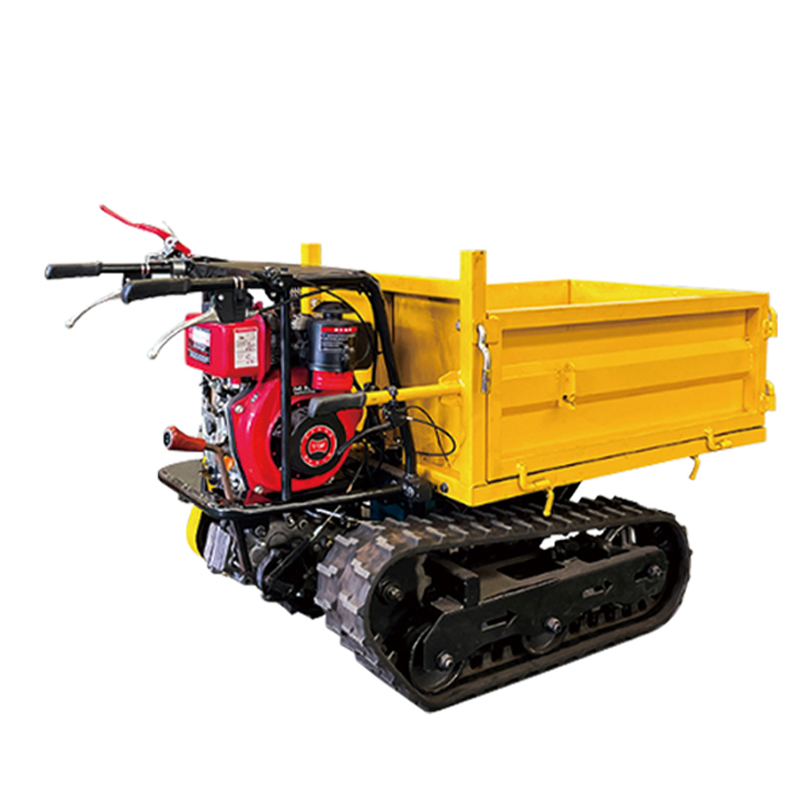
2025-04-25Tracked vehicles can navigate effortlessly through extreme terrains like mud, swamps, and snow due to their unique structural design and mechanical principles. Here’s a detailed analysis:
1. Low Ground Pressure, Preventing Sinking
Large Contact Area
A 10-ton tracked vehicle: Ground pressure ≈ 10,000kg ÷ 4m² = 2.5 kPa (equivalent to the pressure of an adult standing).
A wheeled vehicle of the same weight: Tire pressure ≈ 50–100 kPa (prone to sinking).
The track distributes the vehicle's weight across the entire contact area (wheeled tires have a contact area of ~0.1–0.3m², while tracks can reach 2–5m²).
Continuous Track Support
The rolling track plates create a "moving road," preventing repeated digging in soft mud like tires.
2. Superior Traction
Track Grouser Grip
The cleats (e.g., chevron patterns) on the tracks dig into the mud, providing gear-like traction, 3–5 times stronger than tire treads.
Comparison: Tires easily slip in mud (slip ratio > 30%), while tracks maintain a slip ratio < 10%.
Full-Time All-Wheel Drive
All track segments contribute to propulsion, avoiding the "single-point failure" issue of wheeled vehicles (e.g., one wheel spinning uselessly).
3. Adaptive Terrain Capability
Balanced Multi-Wheel System
Support rollers and road wheels evenly distribute pressure, keeping the vehicle level even if one side sinks (e.g., can escape when one side bears < 30% load in a swamp).
Flexible Track Design
Rubber or metal-hinged tracks bend with terrain contours, conforming to uneven ground (70% better passability than rigid wheels).
4. Extreme Comparison with Wheeled Vehicles
| Parameter | Tracked (Same Tonnage) | Wheeled (Same Tonnage) |
|---|---|---|
| Max Obstacle Height | 0.5–0.8 m | 0.2–0.3 m |
| Speed in Mud | 8–15 km/h | 2–5 km/h (often stuck) |
| Minimum Turning Radius | 1.2 × Vehicle Length | 0.8 × Vehicle Length (but prone to skidding) |
5. Drawbacks and Mitigations
Disadvantages:
Low road speed (≤20 km/h), damages paved surfaces.
Complex maintenance (track pins require regular greasing).
Improvements:
Rubber tracks: Reduce noise and protect hard surfaces (e.g., Kubota T15 for agriculture).
Hydraulic suspension: Enhances ride smoothness (e.g., BvS10 armored personnel carrier).
Conclusion
Tracked vehicles dominate muddy, swampy, and other harsh environments through three core advantages: low-pressure weight distribution, high-traction cleat design, and dynamic terrain adaptability. Their technical essence trades mechanical structure for ground compatibility at the cost of speed and economy. For specialized fields like forestry, oilfields, and military operations, tracked vehicles remain irreplaceable.