

 Chinese
- HOME >> NEWS >> Industry news
NEWS
Latest Product
Contact Us
Where Lies the Advantage of Skid-Steer Loaders in Confined Space Operations?
2025-09-26I. Space Adaptability: "Compact Size" Easily Handles Confined Scenarios
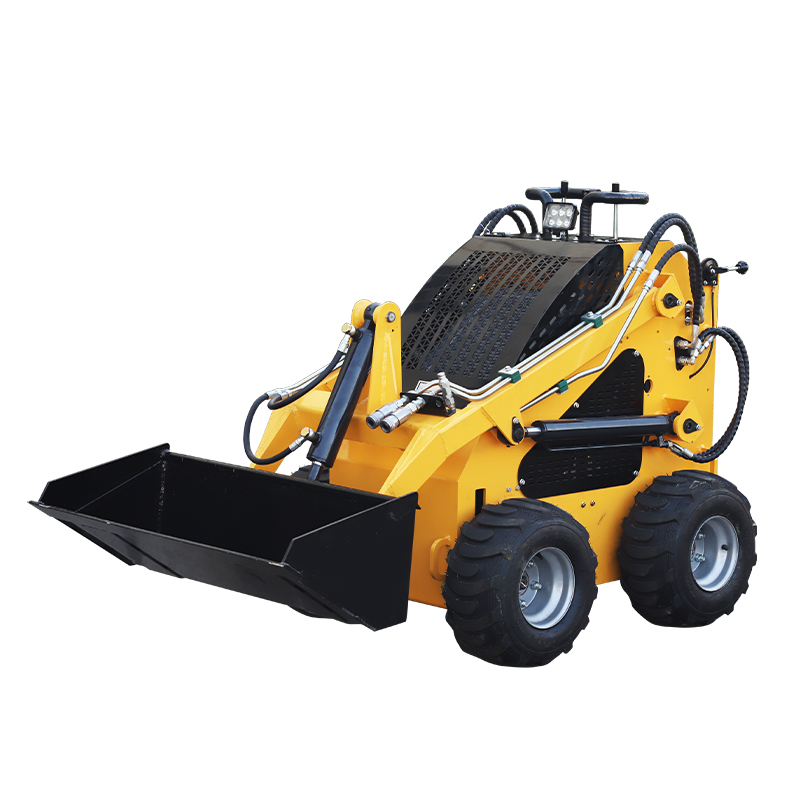
The core constraint of confined spaces is "size limitation," and the structural design of skid-steer loaders fundamentally addresses this issue. Its advantages are reflected in the following aspects:
1. Compact Body with Minimal Space Occupation
A skid-steer loader typically has an overall length of only 2.5-3.5 meters, a width of 1.2-1.8 meters (some micro-models have a width of less than 1 meter), and a height of 2-2.5 meters—far smaller than ordinary wheel loaders (which usually have a length of 4-6 meters and a width of 2-3 meters). It can easily navigate through factory passages (common width: 1.5-2 meters), warehouse shelf gaps (1.2-1.5 meters), foundation pits, and tunnels (width: 2-3 meters) without getting stuck in narrow areas due to an overly large body.
2. No Need for "Steering Redundant Space"
Ordinary loaders rely on "wheel deflection" for steering and require a steering space of at least 1.5-2 times the body width (e.g., a 5-meter-long loader needs a turning radius of 8-10 meters). In contrast, skid-steer loaders steer by "speed difference between wheels on both sides" and even require no additional space for in-place steering (zero turning radius). Even in a narrow passage that "only allows the body to pass through," it can directly turn around or adjust direction without repeated reversing.
3. Small Operating Radius for Obstacle-Proximate Operations
The bucket/attachment of a skid-steer loader is tightly connected to the body, resulting in a small "action radius" during operation (e.g., the bucket does not extend far beyond the body when lifted or flipped). In scenarios where it operates close to walls, equipment, or shelves (such as cleaning factory corners or handling materials near warehouse shelves), it can avoid collisions between the attachment and obstacles. Ordinary loaders, however, have a large operating radius and are prone to scraping surrounding objects.
II. Operational Flexibility: "Precise Control" Adapts to Complex Confined Working Conditions
Operations in confined spaces not only require "being able to enter" but also "being able to operate precisely," and the operational characteristics of skid-steer loaders exactly meet this demand:
1. Coordinated Steering and Travel for More Precise Operation
Skid-steer loaders control the wheel speed via two independent levers (the left lever controls the left wheels, and the right lever controls the right wheels). During steering, small-angle turns (e.g., only 5°-10° deflection) can be achieved by "fine-tuning the speed of wheels on one side." Especially when adjusting the body position in narrow passages, it can precisely control the traveling direction to avoid "over-steering" or "under-steering." Ordinary loaders, which use a steering wheel for steering, make it difficult to precisely control the steering angle and are prone to "deviating from the path" in confined spaces.
2. Strong Stability at Low Speeds for Fine Operations
The hydraulic drive system of skid-steer loaders can achieve "low-speed and high-torque," and the traveling speed during operation can be stably controlled at 1-3 km/h (the low-speed gear of ordinary loaders is mostly 3-5 km/h). When loading and handling materials in confined spaces, it can move the body slowly and coordinate with attachments for precise alignment (such as accurately unloading materials into narrow hoppers or cleaning debris close to the ground), avoiding operational errors caused by excessive speed.
3. No "Blind Spots" for Safer Operation
The cab of a skid-steer loader is usually designed as a "panoramic type" (no 遮挡 or only low 遮挡 around it). With a compact body and a low driver’s seating position, the driver’s field of vision can cover a range of 1-2 meters around the body. In confined spaces, the driver can clearly observe surrounding obstacles, personnel, or equipment. Ordinary loaders, however, have a long body and a high cab, resulting in multiple blind spots (such as the right side and rear of the body), making them prone to collisions due to poor visibility in confined scenarios.
III. Function Coverage: "Multi-Functional in One Machine" Reduces Equipment Entry/Exit Frequency
Another pain point of confined spaces is "inconvenient equipment entry and exit." If multiple operations (such as cleaning, handling, and crushing) are required, frequent equipment replacement will significantly reduce efficiency. The "attachment versatility" of skid-steer loaders can solve this problem:
1. Quick Attachment Replacement for Multi-Scenario Operations
Skid-steer loaders use "quick-change couplers" for attachment connection. Replacing attachments such as buckets, breakers, grapples, and sweepers takes only 5-10 minutes and requires no tool assistance. In confined spaces, a single skid-steer loader can complete multiple processes, such as "cleaning debris (with a sweeper) → handling materials (with a bucket) → crushing hard blocks (with a breaker)," without frequent entry and exit of the confined area to replace equipment. Ordinary loaders, by contrast, require complex procedures to replace attachments (such as removing bolts and adjusting hydraulic pipelines), making it difficult to quickly switch functions in confined scenarios.
2. Miniaturized Attachments for Confined Operation Needs
Most attachments of skid-steer loaders are "miniaturized" (e.g., small buckets with a capacity of 0.3-0.8 m³ and small breakers with impact force suitable for small-scale crushing). During operation in confined spaces, these attachments have more flexible movements (e.g., small grapples can accurately grasp small-volume materials, and small sweepers can clean the ground of narrow passages closely). Ordinary loaders, however, have large-sized attachments (e.g., buckets with a capacity of 1.5-3 m³), which cannot fully expand their movements in confined scenarios and may even be unusable.
IV. Safety and Efficiency: "Low Interference" Enhances Operational Value in Confined Scenarios
In addition to operational advantages, skid-steer loaders can reduce interference with the surrounding environment during operation in confined spaces and improve overall operational efficiency:
1. Minimal Ground Damage for Fragile Ground Surfaces
Most skid-steer loaders use "wide tires" or "tracks" (with a large ground contact area) and have low ground pressure (usually 0.05-0.1 MPa, compared to 0.15-0.2 MPa for ordinary loaders). When operating on narrow indoor concrete floors, warehouse epoxy floors, or compacted dirt roads at small construction sites, they will not damage the ground. Ordinary loaders, however, have high ground pressure and are prone to leaving indentations or damaging fragile ground surfaces, requiring additional steel plates to be laid and increasing operational costs.
2. Low Operational Noise for Indoor/Residential Area Scenarios
The engines of skid-steer loaders are mostly "small-sized and low-noise models" (with a power of 20-50 kW), and the operational noise is usually 75-85 dB (compared to 85-95 dB for ordinary loaders). When operating in confined spaces such as indoor factories or around residential areas, they will not generate excessive noise pollution, meeting environmental protection and workplace requirements. Ordinary loaders, with high noise levels, are often restricted in terms of operating hours when used indoors or in residential areas.
3. Convenient Equipment Entry/Exit to Reduce Site Preparation Time
Skid-steer loaders are lightweight (mostly 1.5-3 tons, compared to 5-10 tons for ordinary loaders) and can be transported by small trailers (such as trailers towed by pickup trucks). Upon arriving at the job site, they can drive down from the trailer directly into confined spaces without the assistance of large cranes or ramps. Ordinary loaders, however, require transportation by large trailers, and before entering confined spaces, the site needs to be leveled and passages widened—resulting in long preparation time (usually 1-2 hours). Skid-steer loaders, by contrast, can achieve "operation upon arrival," saving 30%-50% of site preparation time.